Representation and memory · Part 4 of 4
Neuralese, memristor-inspired AI, and ECI compared
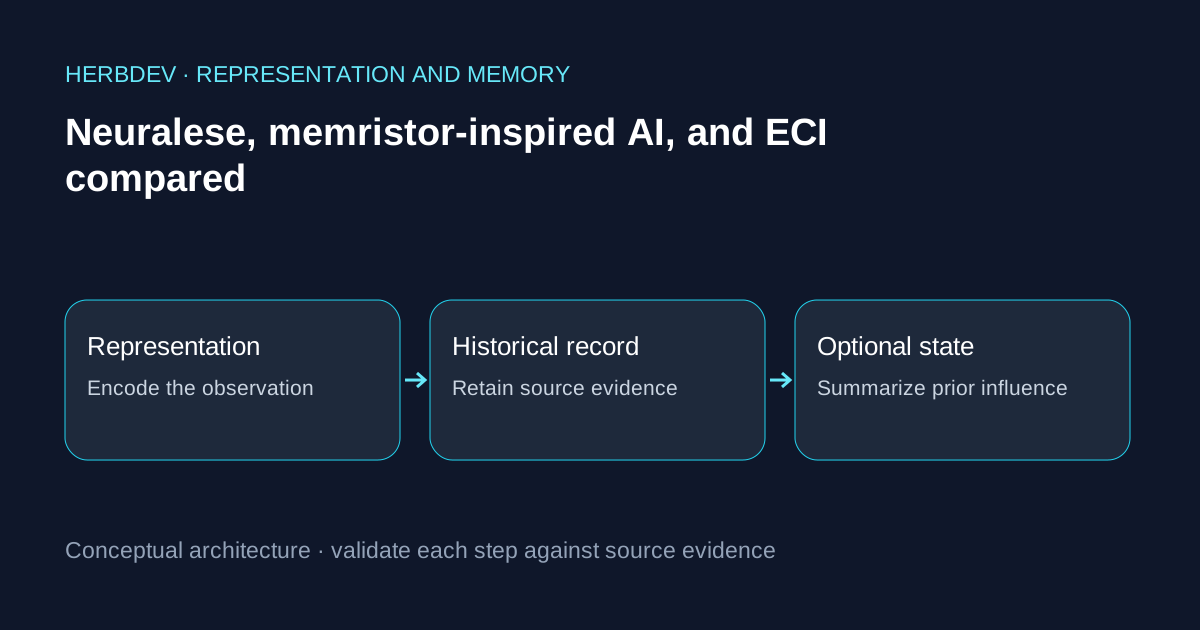
Neuralese, memristor-inspired stateful AI, and Environmental Change Intelligence can sound similar because all three involve information that exists beyond a simple input-to-output classification. They are nevertheless different concepts, and the distinctions are important.
Neuralese is primarily about representation. Memristor-inspired AI is primarily about history-dependent computational state. Environmental Change Intelligence is an applied architecture for understanding how physical places change through repeated observation, embeddings, contextual data, and temporal history.
ECI’s published research platform combines classical and learned evidence with longitudinal history and human review. Field validation remains the next step. Persistent memristor-inspired state is a separate experimental extension, not a demonstrated ECI capability.
Read the narration transcript
Practical Takeaway
Choose the right kind of memory
Compare learned representations, stored environmental history, and persistent computational state, with an ECI example and a practical research roadmap.
Part 4 · 01
The Three Concepts
Neuralese
Neuralese is a conceptual term for machine-native learned representations. Instead of forcing every intermediate result into human words or hand-designed labels, neural components can operate on vectors, latent states, embeddings, and other learned numerical structures.
Memristor-Inspired Stateful AI
Memristor-inspired AI explores persistent internal states whose future behavior depends on prior activity. In software, this can be emulated with state variables that reinforce, decay, saturate, or otherwise evolve as new input arrives.
Environmental Change Intelligence
ECI is an applied system for repeated observation of physical locations. It aligns observations, extracts features, compares learned representations, evaluates persistence, incorporates context, and maintains a longitudinal record so that the system can identify changes that deserve human attention.
Part 4 · 02
Side-by-Side Comparison
Use this comparison to choose the mechanism the task actually needs. A rich representation, a retrievable record, and a changing state serve different roles.
| Dimension | Neuralese | Memristor-Inspired AI | ECI |
|---|---|---|---|
| Primary question | How should the machine represent meaning internally? | How should prior activity alter persistent computational state? | How can repeated observations reveal meaningful environmental change? |
| Core mechanism | Embeddings, latent representations, hidden states | History-dependent state updates; potentially simulated or physical memristive elements | Image registration, features/embeddings, temporal history, context, persistence |
| What persists | Not necessarily anything; a representation can be temporary | The computational state itself | Observations, metadata, embeddings, findings, ground truth, trends |
| Relation to memory | Representation can be stored, but representation alone is not memory | Memory is expressed as changed state that influences future processing | Application-level historical memory and temporal reasoning |
| Human language | Usually an interface or decoder output | Optional; state can exist without language | Used for alerts, reports, review, and explanation |
| Primary value | Rich machine-native communication and comparison | Experience-dependent computation and continual state | Operational detection of abnormal or persistent physical change |
| Main risk | Opaque representations and hidden bias | Drift, instability, uncontrolled reinforcement | False positives, capture variance, confounding environmental conditions |
| Maturity in ECI | Embeddings/learned features are directly applicable | Research direction, not required for current architecture | Working research platform; field validation remains the next step |
Part 4 · 03
The Most Important Distinction: Representation Is Not Memory
An embedding can represent an image with hundreds of learned values. The vector may be extremely informative, but nothing about the existence of the vector requires it to persist. If it is discarded after inference, it was representation without long-term memory.
If the embedding is saved, the application has stored memory. It can retrieve the representation later and compare it with a new observation. This is how ECI can build a useful environmental history.
A memristor-inspired state adds a third possibility: the observation changes a persistent internal variable that alters future processing. That is memory expressed through the computational state itself.
Representation: E(t) = Encoder(X(t))
Stored history: H = {E(1), E(2), ..., E(t)}
Stateful memory: S(t+1) = F(S(t), E(t))
Part 4 · 04
The Second Distinction: Historical Memory Is Still Real Memory
Calling ECI’s longitudinal record “memory” is not incorrect. The system retains information about earlier observations and can use that information later. The important requirement is to specify the kind of memory being discussed.
This vocabulary prevents a common architectural mistake: treating every mechanism that uses the past as though it were the same type of memory.
- Historical or episodic application memory: saved observations and events.
- Semantic or representation memory: embeddings and learned descriptors that can be retrieved.
- Working or transient model state: temporary context active during a computation.
- Persistent dynamical state: state that changes with experience and remains part of future computation.
- Learned parameters: weights changed through training, typically on a slower timescale.
Part 4 · 05
How Neuralese Can Strengthen ECI
ECI can classify changes using human-designed categories, but a location is richer than a category. Learned representations can preserve information about shape, texture, moisture cues, vegetation patterns, geometry, and scene relationships. By comparing representations over time, ECI can detect changes that may not be well described by a single predefined label.
Neuralese-like communication can also allow specialized components to exchange richer information. A vision model can pass a learned state to a temporal model; the temporal model can combine it with context; an anomaly model can evaluate the result; and a language layer can generate the final explanation.
Part 4 · 06
How Memristor-Inspired State Could Extend ECI
An ECI architecture can maintain a history externally and calculate trends when needed. A stateful extension would allow the location itself to have a continuously evolving computational state. Every observation could update that state according to confidence, persistence, weather, season, and human verification.
Repeated evidence of a slow change could strengthen a state. One-time transient changes could decay. Human-confirmed problems could strongly reinforce specific pathways. After repair, a reset or recovery process could gradually move the state toward a stable baseline.
S(location,t+1) = F(S(location,t), E(t), Weather(t), Verification(t))
Part 4 · 07
A Concrete Environmental Example
Imagine an ECI observation point beside an irrigation canal.
Week 1
The image is registered successfully. The learned representation falls within the historical range for the location. No meaningful change is detected.
Week 2
A small damp area appears. Pixel and structural change are moderate. Embedding distance increases slightly. Weather data shows recent rain, so ECI lowers the anomaly confidence.
Week 3
The damp area persists despite dry weather. Its spatial extent increases. The embedding remains outside the normal cluster. ECI raises the location for review.
Week 4
The area expands again and vegetation response becomes visible. ECI reports a persistent moisture anomaly and recommends physical inspection. This complete workflow requires no memristor state. The system can reach the conclusion through stored observations, embeddings, context, and temporal analysis. In a stateful research version, each week would also update a location state. Weak evidence from Week 2 might produce a small increase that later decays if nothing else happens. Repeated evidence in Weeks 3 and 4 could accumulate until a threshold is crossed. The two systems may produce similar outputs, but their internal mechanisms are different.
Part 4 · 08
A Brain-Inspired Combined Architecture
The three concepts can be combined without pretending they are the same. A future architecture could use Neuralese-like latent representations for internal communication, persistent state for experience-dependent processing, and the ECI observation framework for grounding the system in repeated measurements of the physical world.
- Capture an environmental observation.
- Align and quality-check the observation.
- Encode it into a rich learned representation.
- Compare the representation with historical observations.
- Update a persistent location or pathway state.
- Combine state with weather, season, sensors, and prior human verification.
- Estimate anomaly, persistence, severity, and likely trajectory.
- Translate the machine-native result into a human-readable explanation.
- Record human feedback and use it in future analysis.
Part 4 · 09
Why Not Replace the ECI Database With Stateful Memory?
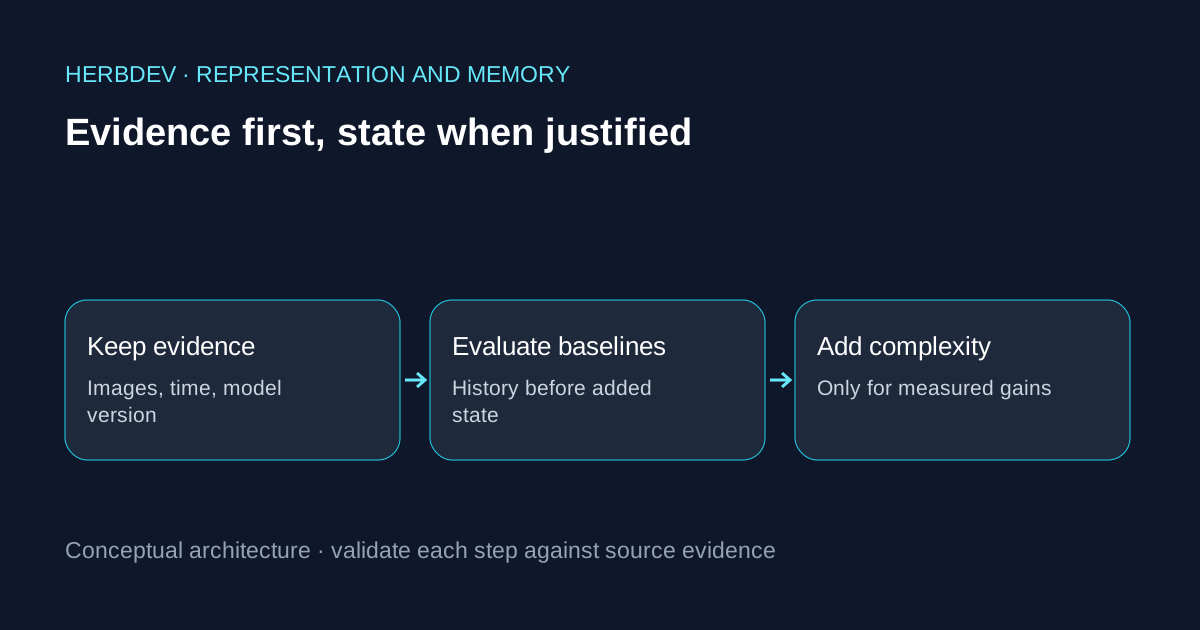
Persistent state should complement, not replace, the immutable historical record. Environmental systems need traceability. A user should be able to see the original image, metadata, previous analysis, model version, confidence, and human decision that contributed to a finding.
A compact state may summarize history efficiently, but summarization loses detail. The source record remains essential for audit, retraining, explanation, and scientific reproducibility. For ECI, the best architecture is likely layered: immutable observations for evidence, embeddings for representation, temporal models for trajectory, and optional persistent state for adaptation.
Part 4 · 10
Conventional AI Versus the Three-Layer Architecture
A conventional isolated classifier can be summarized as Input -> Model -> Label. The combined architecture is closer to Observation -> Representation -> History/State -> Context -> Prediction -> Explanation.
The practical improvement is not that the system becomes “more human.” The improvement is that it can preserve more information, make time a first-class variable, and evaluate new observations in the context of what the same place has done before.
Part 4 · 11
What Each Concept Contributes
Neuralese contributes richness
It gives the machine a high-dimensional internal vocabulary that is not limited to hand-designed labels.
Memristor-inspired state contributes experience dependence
It provides a mechanism through which repeated activity can alter a persistent computational condition.
ECI contributes grounding and longitudinal structure
It ties observations to real places, real times, capture quality, environmental context, human verification, and measurable change.
Part 4 · 12
What the Combined System Should Not Claim
- That embeddings are thoughts in the human sense.
- That a persistent numerical state is consciousness.
- That software emulation is identical to physical memristor hardware.
- That an anomaly establishes the physical cause of an environmental change.
- That brain-inspired architecture automatically outperforms simpler machine-learning methods.
- That historical application memory and persistent dynamical memory are interchangeable.
Part 4 · 13
A Research Roadmap
- Establish the ECI baseline using repeatable capture, registration, classical change detection, and immutable history.
- Add embedding-based comparison and validate whether it reduces false positives or improves sensitivity.
- Build temporal models that learn expected change across multiple observations.
- Create explicit location-state experiments in software and compare them against simpler rolling statistics and recurrent/state-space models.
- Add reinforcement, decay, and confidence-aware state updates only when experiments justify them.
- Evaluate whether representation-level communication between specialized models improves performance or preserves useful information.
- Keep source observations and human verification available for every important decision.
- Measure performance with precision, recall, false-positive rate, detection latency, calibration, and operational usefulness.
Part 4 · 14
The Larger Idea
The three concepts form a progression, not a set of synonyms. Neuralese asks how a machine represents what it sees. ECI asks how observations of the same place become a history of change. Memristor-inspired AI asks how that history might eventually modify the computational state through which the next observation is interpreted.
That leads to a deeper research question: can an artificial system develop a persistent machine-native representation of how a physical environment is changing through time?
Part 4 · 15
Conclusion
ECI does not need memristors to be useful, and an embedding is not a memory state. Those distinctions make the architecture stronger rather than weaker. An ECI research pipeline can use embeddings to compare observations in learned feature space and can use historical records to build a visual memory of the land. Neuralese provides a framework for thinking about richer machine-native representations. Memristor-inspired state provides a separate research direction for making experience part of the computation itself.
Keep the distinction clear
Keep original observations available. A compact state can summarize the past, but it cannot replace an auditable record.