HT
HerbDev Application Rescue

Case Studies

Practical AI and software rescue work, explained through real process examples.

These case studies show the kind of technical ownership HerbDev brings to stuck, unstable, or operationally complex software projects.

AI Process Automation

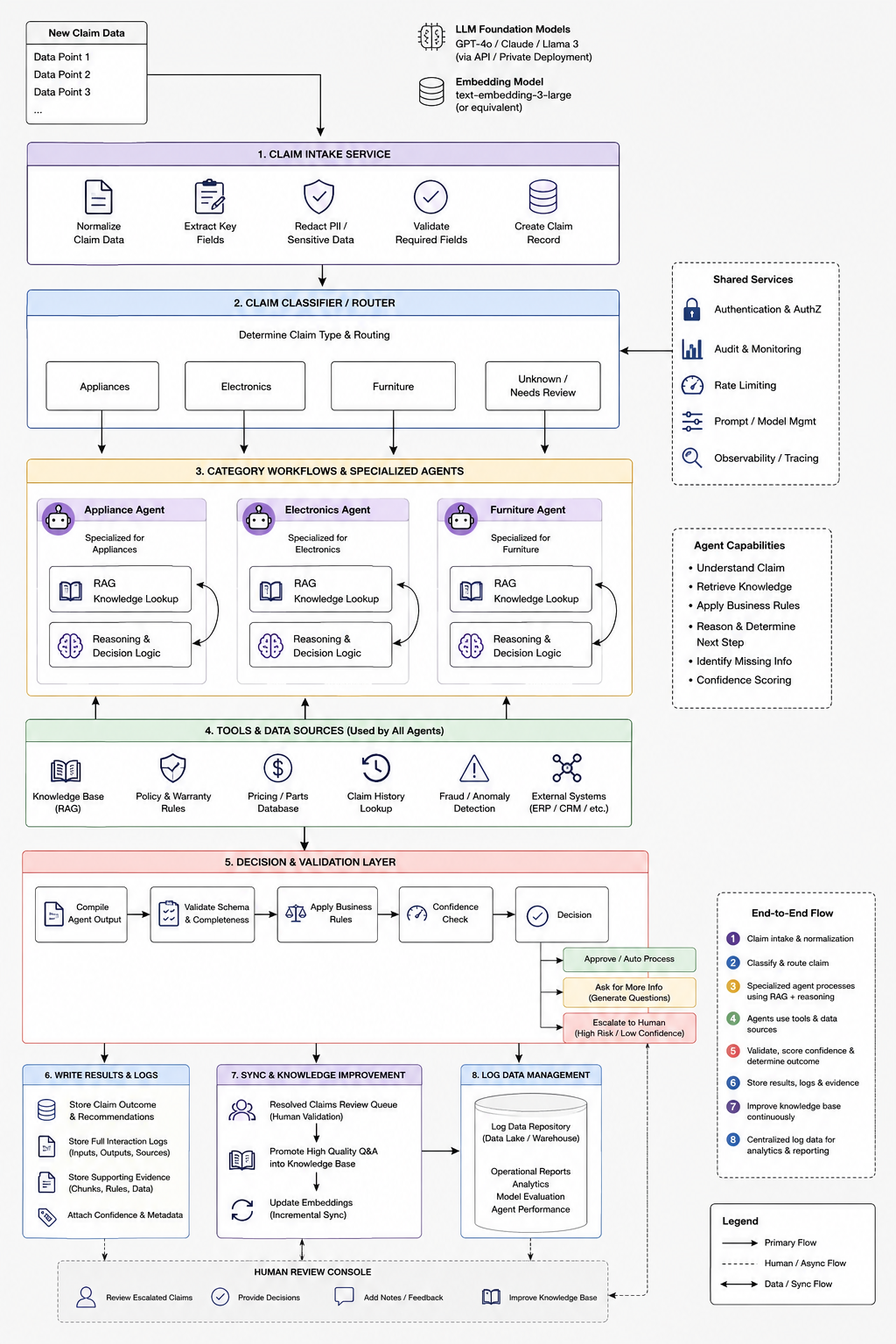
Claim classification and replacement decision workflow

This case study shows an AI process triggered by a function whenever a claim is submitted. The process normalizes the new claim data, classifies whether the claim is for furniture, appliances, or electronics, and routes it to the appropriate specialized workflow.

From there, the system reviews historical repair data, warranty and policy rules, pricing and parts data, claim history, and fraud or anomaly signals. The goal is to determine whether it would be cheaper to replace the item outright instead of sending someone out for one or more repairs.

The workflow includes validation, confidence scoring, audit logging, human review paths, and knowledge-base improvement so the process can be monitored and refined over time.

AI claim intake, classification, specialized agent workflow, validation, logging, and human review process diagram

AI Scheduling Automation

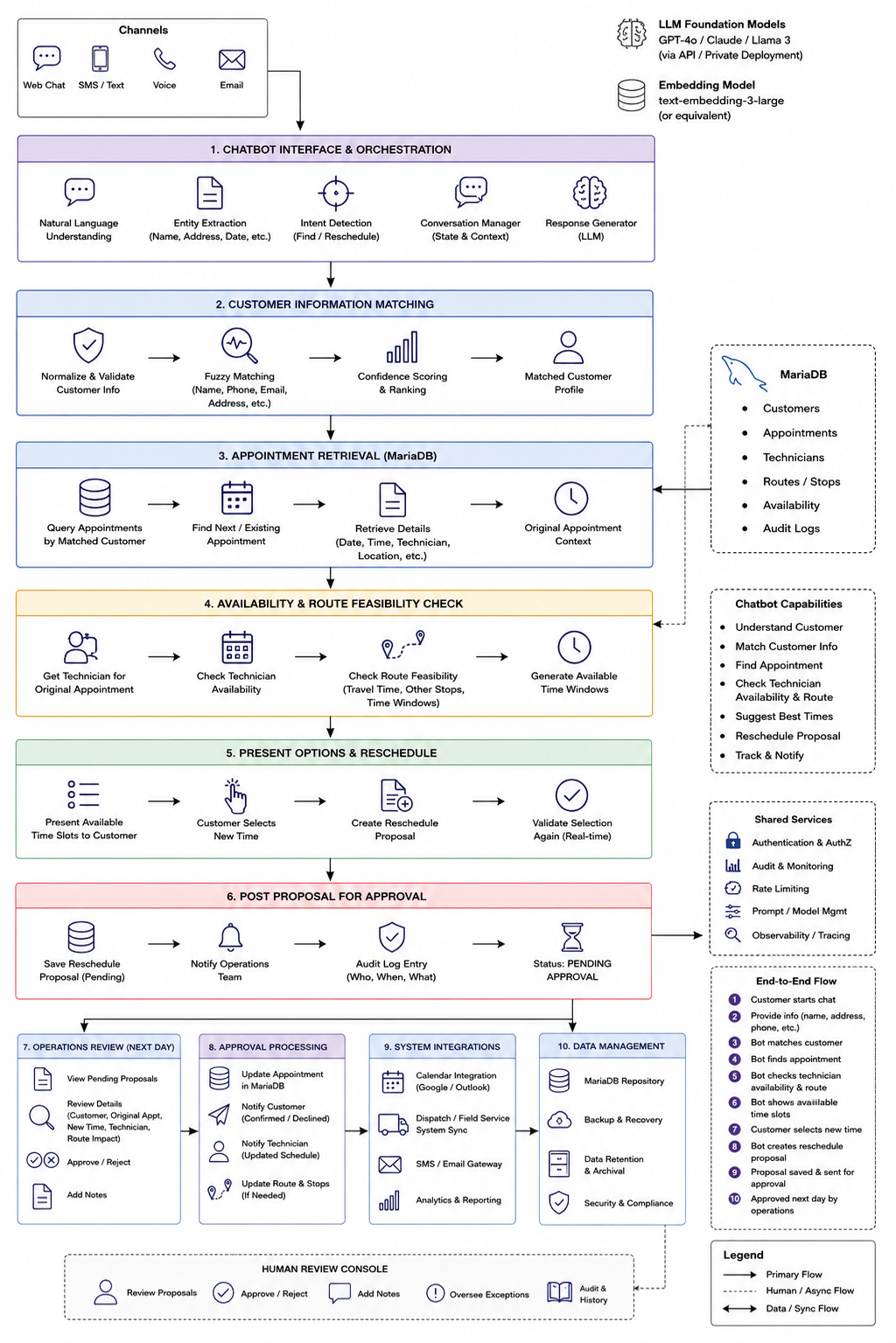
Chatbot appointment matching and route-aware rescheduling workflow

This case study shows a chatbot workflow where the customer enters their information, and the system matches that information against the company database to find the customer profile and locate the existing appointment.

After the appointment is found, the process checks technician availability for new appointment times within the technician's route. It considers the technician's other stops, travel feasibility, and available time windows, then proposes appointment suggestions the customer can choose from.

When the customer selects one of the proposed appointment times, the chatbot creates a reschedule proposal and posts it back to the scheduling system. The next day, the people who manage scheduling and routing can review the pending proposal, approve it, and update the technician's route.

Chatbot appointment matching, technician availability, route feasibility, rescheduling proposal, operations approval, and system integration workflow diagram

Mobile AI Application Architecture

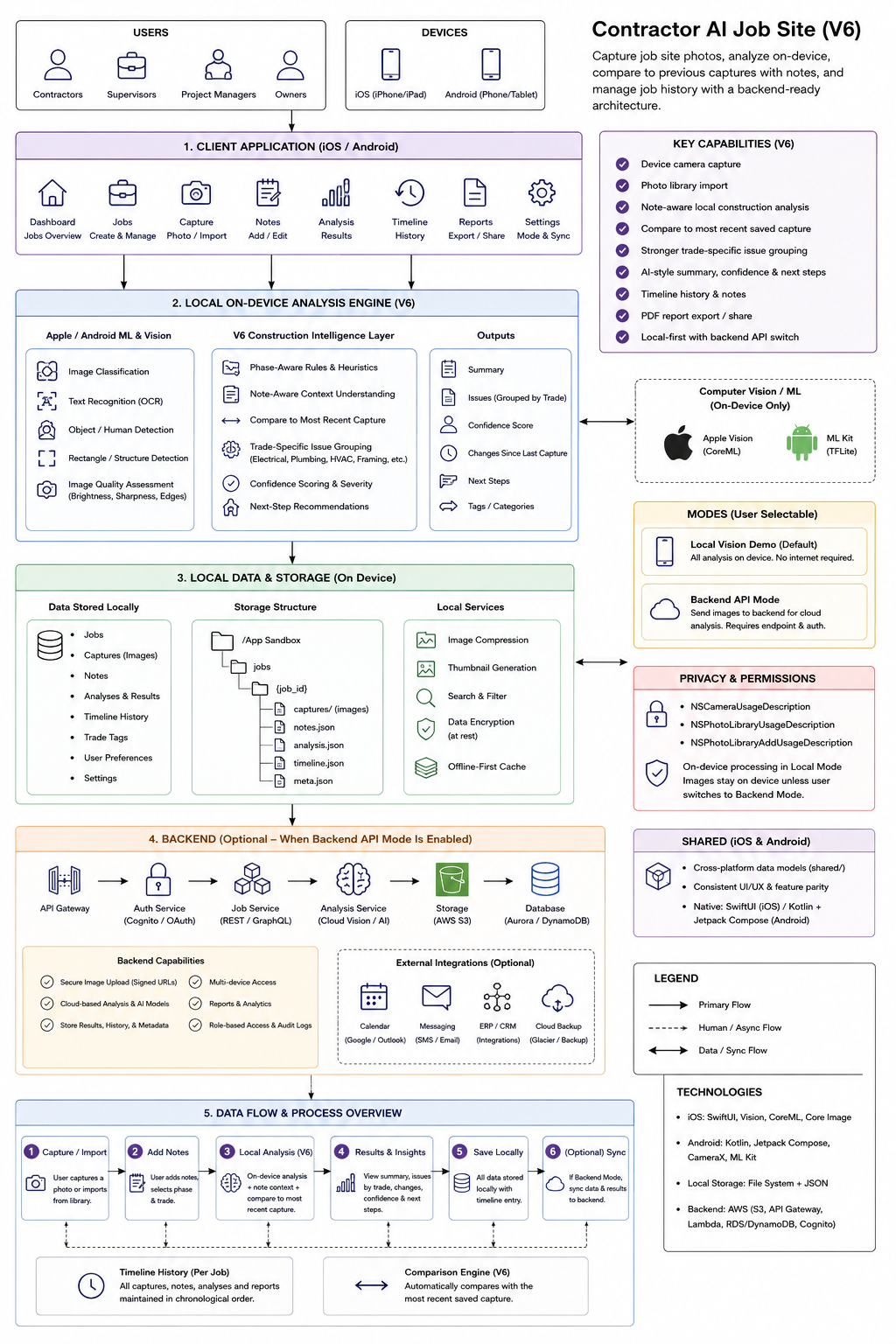
Contractor AI Job Site local vision and backend-ready workflow

This case study shows a cross-platform contractor job site app for capturing job site photos, analyzing them on-device, comparing results to previous captures, and managing job history with a backend-ready architecture.

The local demo flow supports camera capture, photo library import, local job storage, JSON persistence, timeline history, and PDF report export. On-device analysis uses computer vision techniques such as image classification, text recognition, human detection, rectangle detection, and image quality assessment.

The V6 architecture adds note-aware construction analysis, comparison against the most recent saved capture, stronger trade-specific issue grouping, AI-style summary and next-step recommendations, and a mode switch for future backend API analysis.

Contractor AI Job Site cross-platform mobile architecture diagram with local vision analysis, local storage, optional backend services, and data flow

Cross-Platform Sports Coaching App

RunFormCoach running form analysis and remote capture architecture

This case study shows RunFormCoach, an AI running-form coaching app for recording short running videos, displaying a real-time form overlay, and giving practical coaching feedback for individual runners and teams.

The product architecture covers live camera capture, external video import, watch and wear remote capture, session context, on-device pose and movement analysis, runner-specific metrics, local storage, optional backend services, and export or sharing workflows.

The app supports Solo mode for individual runners and Team mode for coaches. Feedback is organized into coaching-language buckets such as Looks good, Watch this, and Try this next run, with non-medical disclaimers, saved history for paid tiers, and a backend-ready path for cloud sync, analytics, and multi-device team workflows.

RunFormCoach cross-platform running form analysis architecture diagram with capture input, on-device analysis, local storage, backend services, premium tiers, and watch or wear remote control

iOS Companion App Architecture

Tesla Performance Coach safety-first Fleet API companion app

This case study shows Tesla Performance Coach, an iOS 17+ SwiftUI companion app for coaching, efficiency insights, charging habits, battery readiness, preconditioning guidance, trip preparation, and drive-session review.

The V1 architecture is intentionally App Store-safe. It provides coaching and informational insights only, without tuning, unlocking, spoofing, or altering Tesla firmware, acceleration, braking, Autopilot, battery controls, motor behavior, or safety systems.

The app uses MVVM-oriented SwiftUI screens, local demo mode, Codable JSON persistence, Keychain token storage scaffolding, a separated network layer, and Tesla Fleet API integration scaffolding for owner-authorized access. Demo mode works without Tesla credentials or network calls, while connected mode is designed around official Tesla Fleet API and OAuth requirements.

Tesla Performance Coach iOS companion app architecture diagram with SwiftUI screens, MVVM view models, services layer, local storage, Tesla Fleet API scaffolding, security, and end-to-end user journey