Representation and memory · Part 2 of 4
Memristor-inspired stateful AI
Most deployed machine-learning models behave like highly capable functions: provide an input, run it through learned parameters, and receive an output. The model may have been trained on enormous amounts of history, but the individual deployed inference does not necessarily modify the model simply because a new observation occurred.
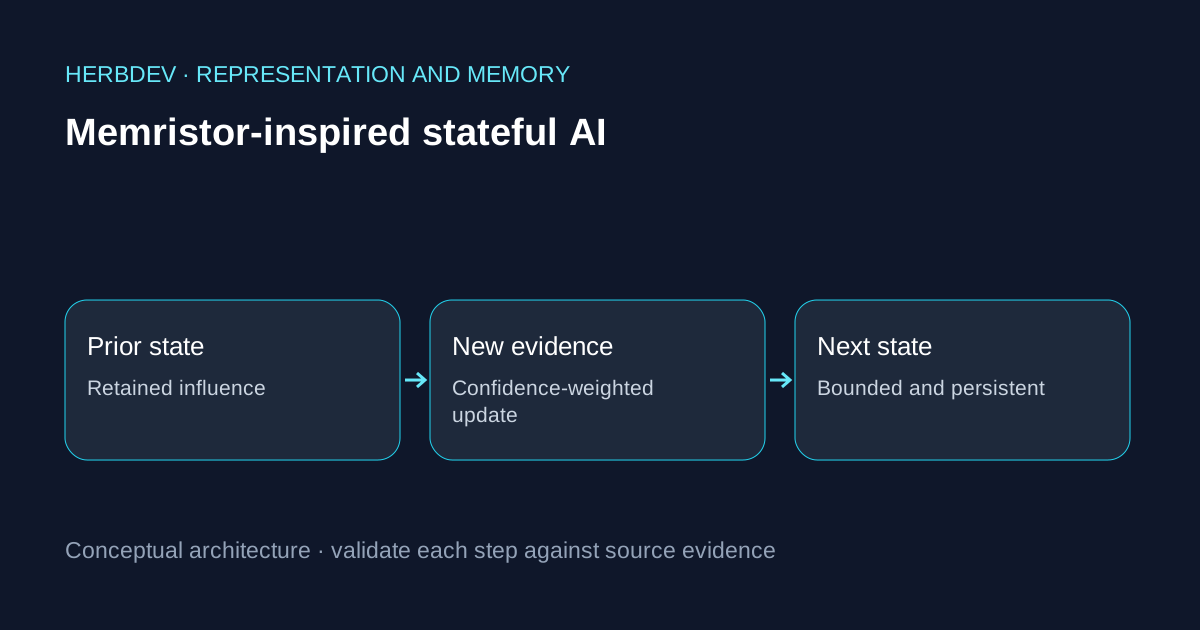
Memristor-inspired AI explores a different idea: what if part of the computational system retains a persistent state that changes because of previous activity, and that changed state influences future processing?
ECI’s published research platform combines classical and learned evidence with longitudinal history and human review. Field validation remains the next step. Persistent memristor-inspired state is a separate experimental extension, not a demonstrated ECI capability.
Read the narration transcript
Practical Takeaway
History can change the next computation
Explore history-dependent computational state, software experiments, decay, reinforcement, and the limits of memristor-inspired AI.
Part 2 · 01
What Is a Memristor?
A memristor is an electronic device whose electrical response depends on an internal state influenced by its previous electrical history. In neuromorphic research, that property is attractive because it provides a physical mechanism that can resemble one important characteristic of biological synapses: past activity can change the effectiveness of a connection.
A simplified conceptual update rule is:
M(t) represents the current state, X(t) represents new activity, and M(t+1) is the updated state. The exact physics of real devices can be much more complex. For a software architecture, the equation is useful because it captures the essential idea that present state depends on past state plus new input.
M(t+1) = f(M(t), X(t))
Part 2 · 02
Why This Is Different From Ordinary Model Weights
Neural-network weights also represent learned connection strengths, but in conventional deployment they are often fixed after training. An inference changes activations, not necessarily the persistent parameters. A memristor-inspired system deliberately introduces state variables that can continue to evolve during operation.
That distinction produces two different patterns:
- Conventional inference: Input -> fixed learned model -> output.
- Stateful inference: Input + current state -> output + updated state.
(X(t), S(t)) -> (Y(t), S(t+1))
Part 2 · 03
A Software Memristor Emulator
Physical memristor hardware is not required to investigate the architectural idea. A software emulator can assign each simulated connection or memory element a persistent state and define rules for reinforcement, decay, saturation, thresholds, and interaction with incoming signals.
For example, a simulated state could be updated using a simplified rule:
Here λ controls how much of the previous state remains and Δ(t) represents the effect of the new experience. If λ is less than one, old influence fades unless reinforced. If repeated observations produce positive updates, the state can strengthen over time.
This rule is a leaky accumulator inspired by history dependence. It does not model device current-voltage behavior or establish neuromorphic performance. Save state and its version transactionally, and retain observations so updates can be replayed.
Possible state behaviors
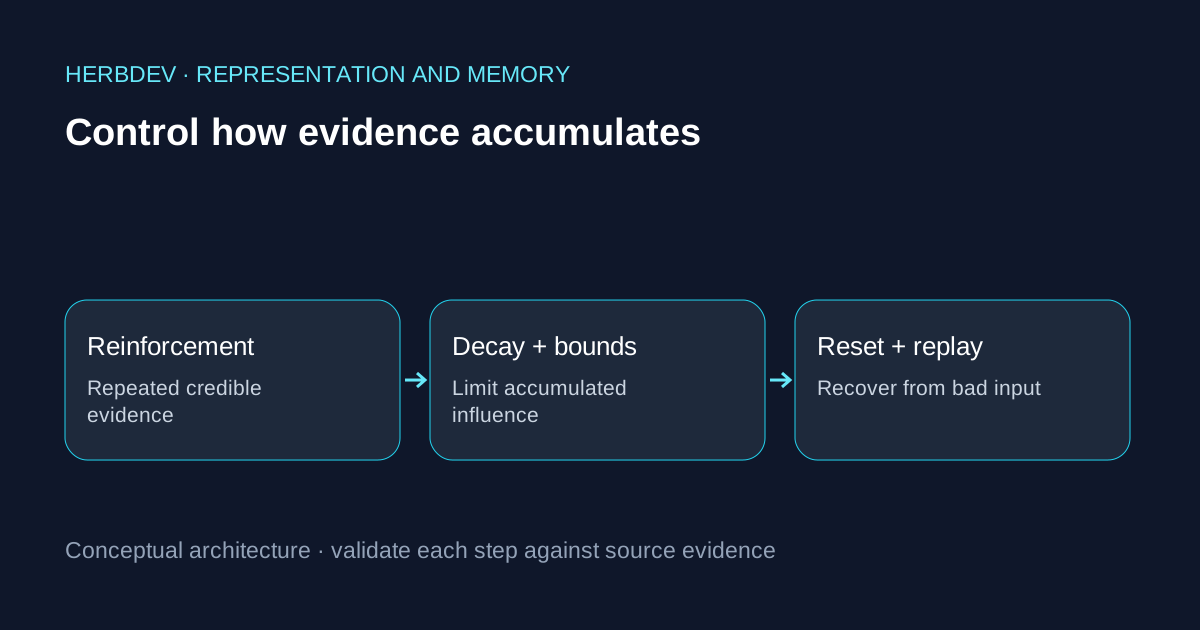
- Reinforcement: repeated activity increases the effect of a connection or memory trace.
- Decay: unreinforced state gradually becomes weaker.
- Saturation: state has upper and lower bounds rather than growing without limit.
- Thresholding: state produces a stronger system response only after accumulated evidence crosses a threshold.
- Competition or inhibition: strengthening one pathway can reduce the influence of another.
- Multiple timescales: some states change quickly while others consolidate slowly.
# Illustrative bounded state update, not a physical device simulation.
def update_state(state, evidence, confidence, elapsed_days,
                 retention_per_day=0.95):
    if elapsed_days < 0 or not 0 <= confidence <= 1:
        raise ValueError("Invalid time interval or confidence")
    retained = state * retention_per_day ** elapsed_days
    return max(0.0, min(1.0, retained + confidence * evidence))
Part 2 · 04
Stored Information Versus Changed State
A database remembers by storing a record that can later be retrieved. A memristor-inspired architecture can remember in a different sense: previous activity changes a state that participates directly in future computation.
Suppose an AI repeatedly observes a pattern. A database-oriented design might save four observations and retrieve all four when analysis is requested. A stateful design might also save the evidence, but it can additionally accumulate a state that becomes stronger with repeated observations.
Part 2 · 05
Short-Term, Working, and Persistent State
A brain-inspired simulator does not need every state to last forever. Different variables can operate at different timescales. Fast state can capture immediate context, intermediate state can support working memory, and slowly changing state can represent persistent experience.
- Immediate state: milliseconds to seconds; useful for local signal dynamics.
- Working state: seconds to minutes; useful for an ongoing task or sequence.
- Persistent state: hours, days, or longer; useful for accumulated experience.
- Consolidated parameters: changes made through deliberate training or offline learning.
Part 2 · 06
What Makes the Architecture Brain-Inspired
The purpose of the analogy is not to claim that software has recreated a biological brain. The useful similarity is narrower: biological neural systems are dynamic, history-dependent systems in which connections and cell states can be affected by prior activity. A stateful artificial network can investigate whether similar principles improve adaptation, temporal reasoning, anomaly detection, or continual learning.
Part 2 · 07
Relationship to Recurrent Networks and Other Stateful Models
State is not unique to memristors. Recurrent neural networks, LSTMs, state-space models, transformers with context, recurrent memory systems, and dynamical systems all provide mechanisms for information from earlier steps to influence later computation. The memristor-inspired distinction is the emphasis on persistent, history-dependent connection or element state and, potentially, a path toward neuromorphic hardware.
That means a software memristor emulator should be evaluated against simpler alternatives. If an ordinary recurrent or state-space model solves the problem more reliably, the more exotic architecture must justify its added complexity through measurable benefits.
Part 2 · 08
The Continual-Learning Opportunity
A deployed system that changes state while it operates raises the possibility of continual adaptation. It can become sensitive to repeated patterns without requiring a complete retraining cycle after every observation. This is potentially useful when the environment changes continuously and the system needs to maintain a local history.
However, continual adaptation also creates risk. A system can drift, reinforce noise, learn from incorrect feedback, or become unstable. Persistent state therefore requires explicit rules for confidence, decay, reset, audit, and recovery.
Part 2 · 09
What a Rigorous Experiment Should Measure
- Does persistent state improve prediction or detection compared with a stateless baseline?
- How quickly does useful state form?
- How quickly should irrelevant state decay?
- Can the model distinguish repetition from accidental correlation?
- Does accumulated state improve performance on long-term trends?
- Can the system recover after bad or misleading input?
- Is the state interpretable enough to audit?
- What is the computational cost compared with recurrent or state-space alternatives?
Part 2 · 10
Connection to Neuralese
Memristor-inspired memory and Neuralese solve different problems. Neuralese concerns how information is represented. Memristor-inspired state concerns how previous activity changes future computation. They can be combined by allowing learned representations to update persistent state.
In this equation z(t) is a learned representation of the current observation and S(t) is the accumulated internal state. The representation describes the new experience; the state preserves its influence.
S(t+1) = F(S(t), z(t))
Part 2 · 11
Connection to Environmental Change Intelligence
Environmental monitoring is naturally temporal. A bank erodes gradually, vegetation stress progresses, a wet area persists, and a shoreline moves. A stateful architecture could assign persistent states to locations, features, or anomaly pathways and update them as new evidence arrives. Repeated weak evidence could accumulate while one-time noise could decay.
This is a research direction rather than a requirement for useful ECI. ECI can build historical environmental memory from stored observations and classical comparisons; learned embeddings and temporal models are extensions to evaluate. A memristor-inspired layer would investigate whether making history part of the computation itself creates additional value.
Part 2 · 12
What Memristor-Inspired AI Does Not Mean
- A software emulator is not equivalent to physical memristor hardware.
- Persistent state does not imply consciousness or subjective experience.
- History-dependent state is not automatically better than a database or recurrent network.
- A changing state must be controlled to prevent drift and instability.
- Brain-inspired does not mean biologically identical.
Part 2 · 13
Conclusion
Memristor-inspired AI is interesting because it changes the role of memory. Instead of treating memory only as information stored outside the model, the architecture can let previous activity alter persistent computational state. That creates a system in which experience can affect the pathway through which future experience is interpreted.
Keep the distinction clear
Persistent state must earn its complexity against rolling statistics, recurrent models, and replayable historical analysis.