Engineering Leadership
AI-native engineering: from individual practice to organizational scale.
AI can generate code quickly. That does not automatically create reliable products, faster releases, or better business outcomes. Real leverage comes from changing how engineers prepare work, how agents execute it, how humans verify it, and how organizations decide what deserves to be built.
Published 2026-03-07 | By Herb Trevathan
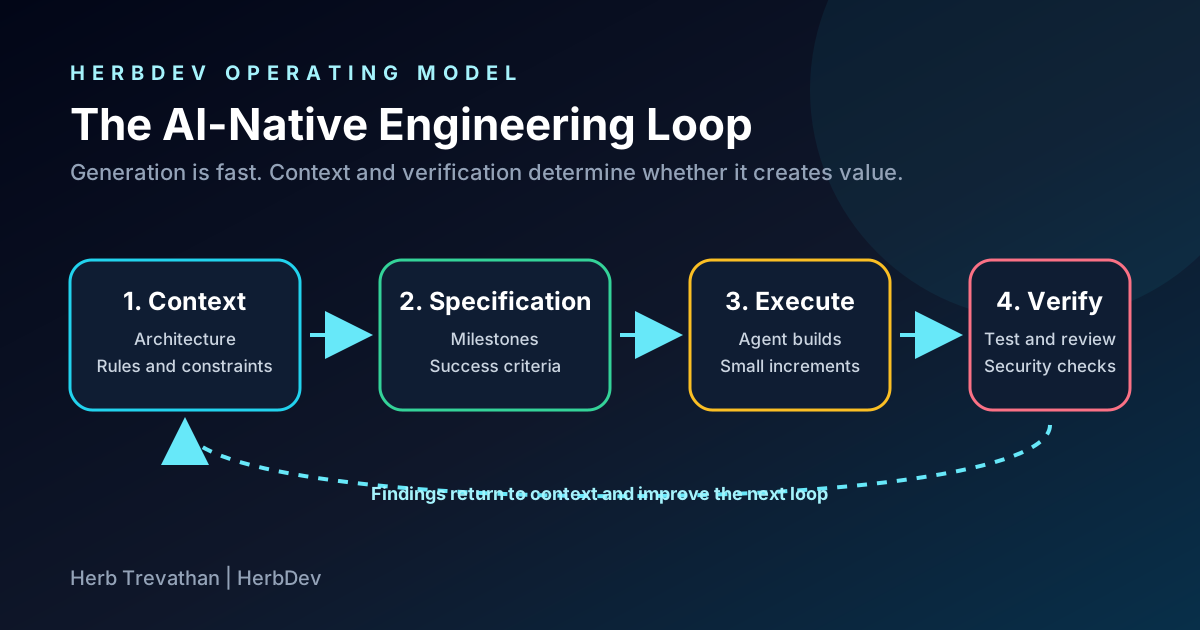
Execution changed
Code generation is becoming cheaper, faster, and more parallel.
The bottleneck moved
Context, judgment, verification, user understanding, and ownership now limit progress.
The operating model matters
Adding tools to a broken process produces more output without fixing delivery.
The Individual Shift
The engineer becomes the orchestrator.
Engineering was never only typing code. It includes deciding what should exist, understanding constraints, designing systems, managing risk, testing behavior, and communicating tradeoffs. AI makes this easier to see because it accelerates construction while leaving the hard judgment intact.
An AI-native engineer can direct one or more agents, provide the correct context, break work into verifiable pieces, evaluate generated changes, and retain responsibility for the result. Knowing how software works remains fundamental. Without that knowledge, generation can create a working demo while hiding security, maintenance, and architecture problems.
Context engineering
Give agents the architecture, standards, business rules, workflows, examples, and constraints they need. Reusable context files and shared knowledge are operating infrastructure, not optional documentation.
Specification-driven development
Define the desired behavior before generating code. Break work into milestones, state success criteria, identify open questions, and make the agent stop when essential information is missing.
Critical verification
Treat generated work like code from a fast but inexperienced contributor. Review assumptions, test behavior, inspect security, and verify the result against the original objective.
Problem decomposition
Keep tasks small enough to reason about and verify. Large autonomous runs accumulate polluted context, hidden assumptions, and expensive rework.
A practical time split
Spend roughly 40% of the effort preparing context and specifications, 20% generating and iterating, and 40% reviewing, testing, and verifying. Generation is the fast part. Confidence is the work.
Individual Development
Move through foundation, integration, and ongoing mastery.
1. Foundation
Choose one primary assistant and use it daily. Learn where it helps, where it drifts, and when it creates more review work than it saves. Record what you learn and establish a repeatable workspace.
2. Integration
Create project context, adopt plan-execute-review loops, add approval gates, and verify after each atomic task. Small loops usually outperform long speculative runs.
3. Mastery
Coordinate multi-file and multi-agent work, use independent review agents, run parallel exploration, and keep adapting as tools improve. High generation rates matter only when rewrite and defect rates remain low.
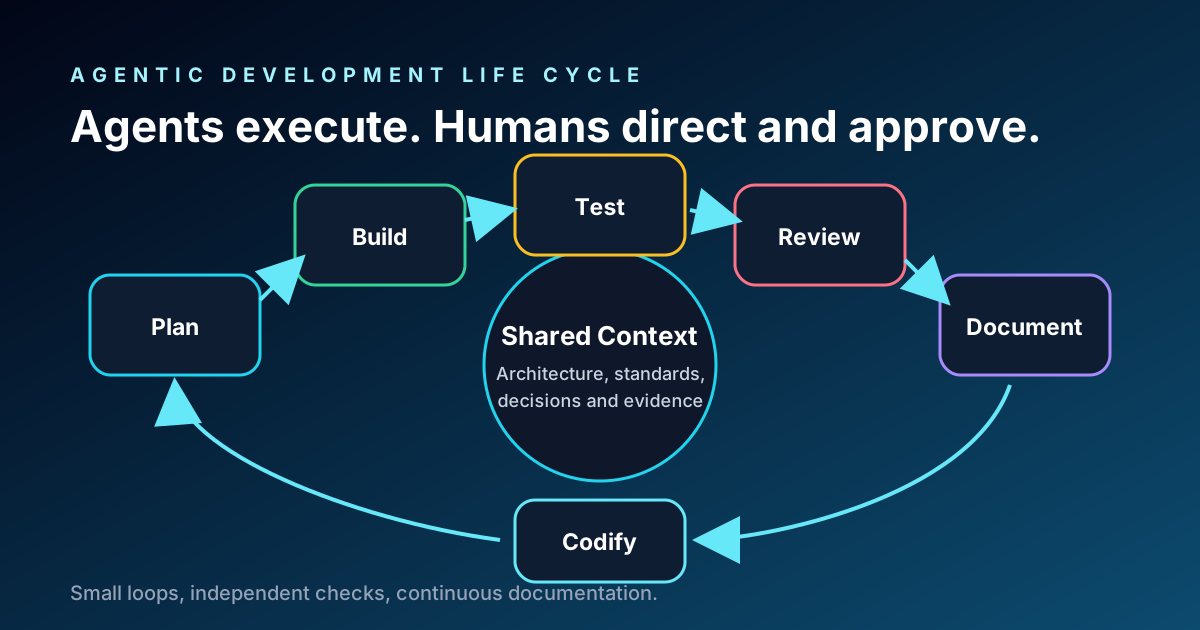
Agentic Development Life Cycle
Replace one large generation step with a controlled lifecycle.
Planning
Explore the codebase, identify ambiguity, decompose the problem, estimate risk, and produce versioned milestones before editing.
Building
Let agents implement bounded tasks sequentially or in parallel while the engineer acts as technical lead and protects module boundaries.
Testing
Write the test plan early. Cover atomic behavior, integration paths, and end-to-end user workflows rather than relying only on unit tests.
Review
Review behavior, quality, speed, uptime risk, security, and privacy. When one defect appears, search for the pattern across the system.
Documentation
Generate changelogs, decisions, diagrams, API notes, and operational instructions continuously while the context is fresh.
Codification
Promote proven practices into maintained context files, reusable skills, commands, evaluation sets, and approved tools.
Security and Quality
Guardrails are part of the architecture.
Faster generation expands the attack surface and increases the volume of code that must be understood. Agents can follow malicious instructions embedded in external content, request excessive access, introduce unsafe dependencies, or produce plausible code with subtle flaws.
- Use a distinct identity for every agent and grant only the permissions required for the current task.
- Start with read-only workflows before allowing agents to write data, deploy code, change configuration, or contact customers.
- Treat documents, web pages, user input, and tool output as untrusted content that may contain prompt-injection instructions.
- Run agents in observable sandboxes with audit logs, blocked production surfaces, and explicit approval for sensitive actions.
- Centralize type checking, linting, static analysis, dependency checks, tests, and security scanning in CI/CD.
- Require human review for authentication, payments, personal data, permissions, infrastructure, and other high-impact code.
- Preserve engineering fundamentals by asking for explanations, reviewing generated code, and periodically completing work without assistance.
Verification rule
Never let the same unchecked assumption survive every stage.
Separate planning, implementation, testing, and review perspectives when risk justifies it. Independent checks reduce the chance that one confident but incorrect interpretation propagates from specification to production.
Product Judgment
The hardest problem was never building.
AI lowers construction cost. It does not decide which problem matters, which workflow frustrates a customer, which tradeoff people will accept, or which feature should be removed. Cheap generation can tempt teams into shipping more options when users need less complexity.
Use AI to make experimentation cheaper. Build the smallest functional version that exposes the core user journey. Look for points where people slow down, get confused, or abandon the flow. Then improve the parts supported by evidence and kill ideas that do not create value.
Automate mechanics
Scaffolding, routine tests, documentation, migrations, data models, repetitive integration work, and draft analysis are strong candidates.
Retain judgment
Customer empathy, product taste, architecture, risk acceptance, domain-specific decisions, and determining what to stop remain human responsibilities.
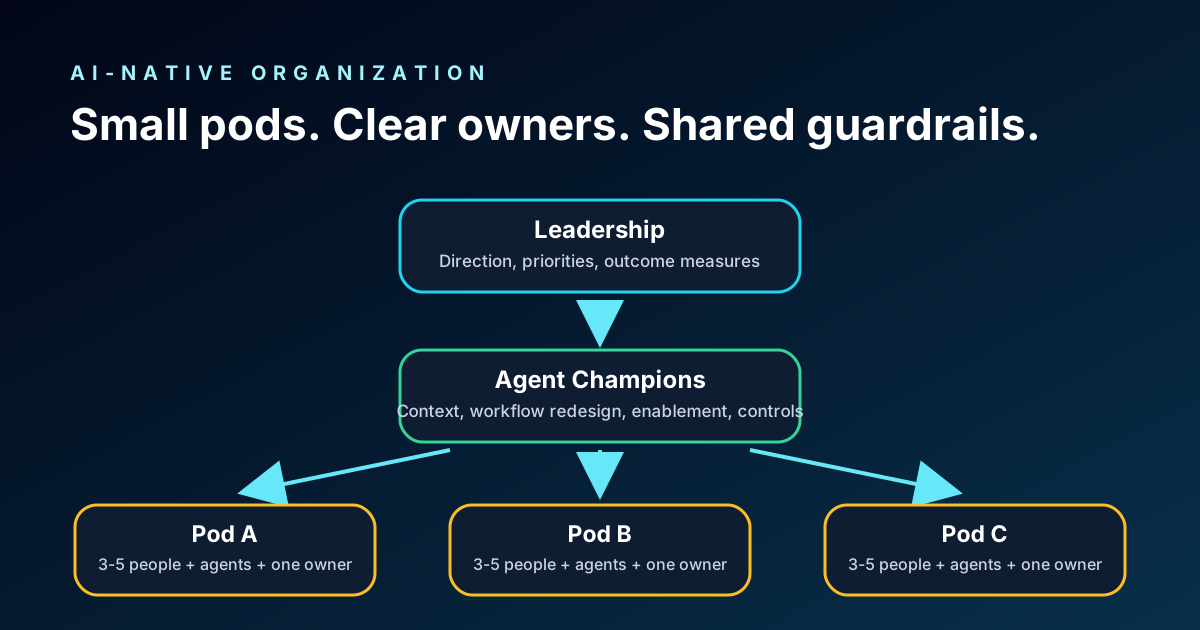
Organizational Design
Use small pods, dedicated champions, and clear ownership.
A practical unit is a cross-functional pod of roughly three to five people working with approved agents and shared controls. Roles can flex as AI removes procedural bottlenecks, but accountability cannot become fluid.
Agent Champions should have substantial dedicated time to prepare codebases, redesign workflows, standardize context, coach teams, and remove barriers. This is transformation work, not a side assignment.
Every important initiative needs one clearly named owner with priority, authority, and decision rights. AI expands the amount of parallel work; ambiguous ownership turns that expansion into coordination debt.
Human-Agent Collaboration
Move from one assistant to a controlled council of agents.
Specialized agents can work by role, evaluate the same problem independently, or form an assembly line where one plans, another builds, another tests, and another reviews. The point is not to maximize agent count. The point is to create independent perspectives and clear handoffs.
Role-based delegation
Assign narrow responsibilities such as architecture, implementation, security, testing, documentation, or analysis.
Cross-evaluation
Have agents analyze independently and challenge each other's assumptions before a human accepts the result.
Human on the loop
Humans set direction and success criteria. Agents execute and self-check. Humans inspect evidence and approve the outcome.
Measurement
Measure outcomes, not code volume.
Coding is only one portion of engineering time. Faster generation may shift the burden into review, testing, coordination, and governance. Track the whole delivery system.
Cycle time
Time from validated problem to reliable production result.
Quality
Defects, incidents, rework, maintainability, security, and customer trust.
Learning velocity
How quickly teams validate or reject product and technical hypotheses.
Business impact
Revenue, retention, service capacity, cost, risk reduction, or user outcomes.
Transformation Anti-Patterns
Faster failure has recognizable symptoms.
- Tool bolt-on: adding AI without redesigning the surrounding workflow.
- Review bottleneck: generation accelerates while testing and review remain unchanged.
- Prompt cargo culting: copying prompts without the codebase and business context that made them useful.
- Metrics gaming: rewarding generated-code percentages or tool logins instead of customer and business outcomes.
- Security shortcuts: allowing privileged agents to act without isolation, authorization, and audit controls.
- Knowledge debt: generated implementation grows faster than specifications, documentation, and verification evidence.
- Junior pipeline hollowing: removing the work where early-career engineers learn judgment and system behavior.
- Meeting creep: using time saved by generation to create more coordination overhead.
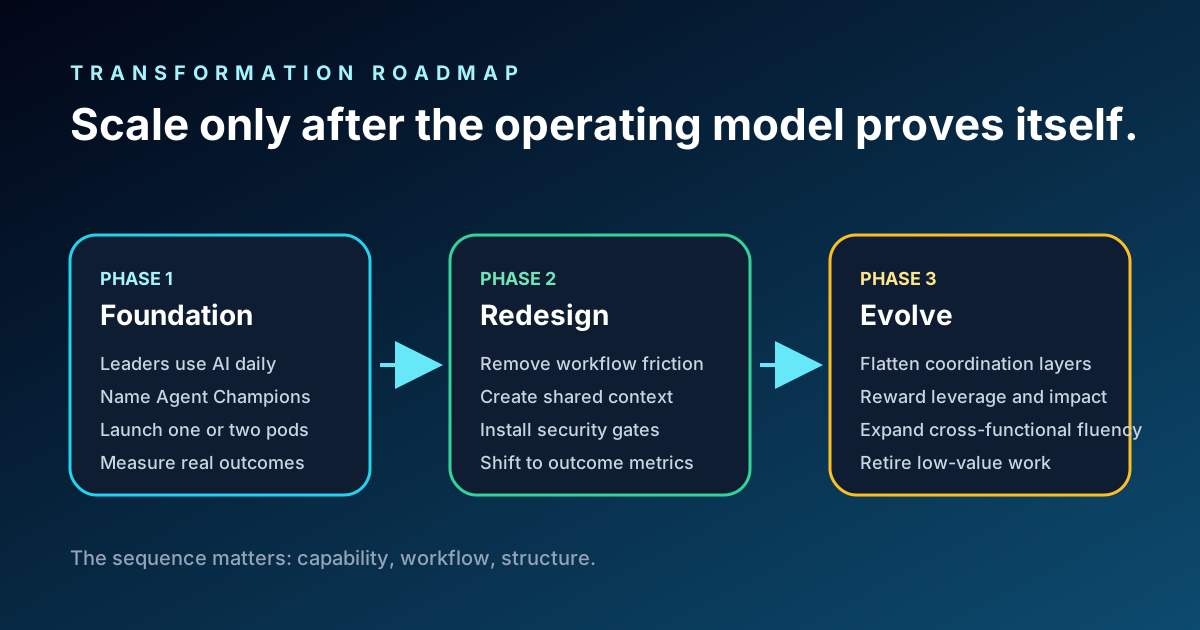
Phased Playbook
Build capability before changing the organization around it.
Phase 1
Foundation
Leaders use AI personally. Name dedicated champions. Assess codebase readiness. Form one or two autonomous pilot pods around real, important problems. Scale only after evidence supports it.
Phase 2
Systematic redesign
Audit manual friction, build AI-readable documentation, install security and verification layers, normalize learning from failures, and shift measurement from output to outcome.
Phase 3
Structural evolution
Remove coordination layers that no longer add value. Reward leverage and outcomes rather than headcount. Expand cross-functional fluency while keeping ownership and quality standards explicit.
Leadership Readiness
Five questions reveal whether the organization is ready.
- 1 If delivery became ten times faster, would users receive ten times more value?
- 2 Do you understand user friction well enough to remove features instead of continuously adding them?
- 3 Does every major initiative have one person accountable for the outcome and empowered to decide?
- 4 Are teams testing a hypothesis with a clear stop signal, or polishing a product without evidence?
- 5 Are you measuring learning speed, quality, cycle time, and business results rather than code volume?
The Leadership Imperative
AI changes what process is for.
Traditional process coordinated human execution. AI compresses execution and increases the number of ideas, prototypes, and changes that can exist at once. The process must now protect attention and accelerate learning.
What are we learning this week?
Reward faster, deeper evidence about users, systems, and risks.
What are we stopping this week?
Retire features, experiments, agents, and projects that lack genuine value.
Who owns each bet?
Name the accountable person and the objective signal that would change the decision.
HerbDev Perspective
The scarce resource is no longer generation. It is judgment.
AI-native teams do not win because they generate the most code. They win because they choose better work, provide better context, verify more rigorously, create clear ownership, and maintain systems after the first burst of automation. That is the difference between faster output and durable technical leverage.