AI Explained
From prompt to response: how AI actually works.
Published 2026-02-06 | By Herb Trevathan
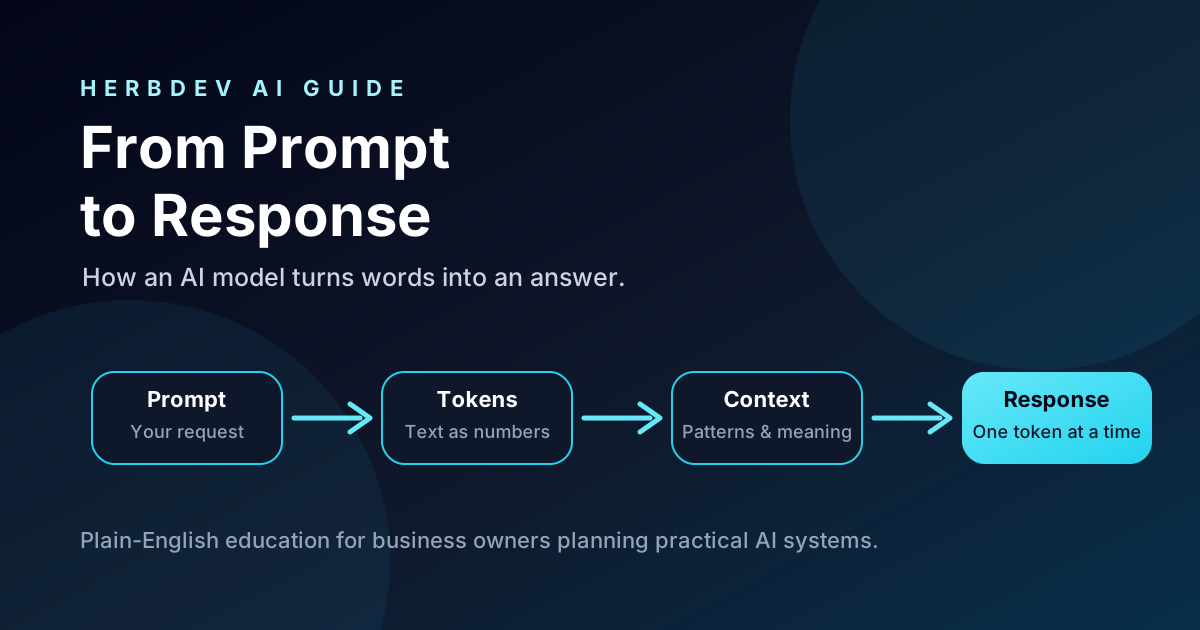
A plain-English guide for business owners and software teams who want to understand what happens after someone types into an AI system. The short version: the model turns words into math, weighs the surrounding context, predicts the response piece by piece, and should be wrapped in controls before it affects real operations.
Educational overview: This page intentionally simplifies the model pipeline so nontechnical readers can understand the main ideas. The full breakdown covers the deeper processing stages, architecture choices, safety checks, caching, sampling, and production optimizations.
Read the narration transcript
Simple truth
AI is not magic.
It is pattern matching at enormous scale. The model predicts likely text based on training, prompt context, and system instructions.
Business risk
It can sound confident.
A useful answer can still be incomplete, outdated, or wrong. Operational AI needs data boundaries, validation, logs, and review paths.
Practical design
Workflow matters.
The best AI projects define the job, allowed data, tool access, confidence checks, and human approval before implementation.
The Pipeline
What happens after a user sends a prompt.
Most client-facing AI conversations can be understood as a repeatable pipeline. The model does not simply "know" the answer. It processes input, weighs context, predicts text, and may use tools if the application allows it.
Your prompt is received
The system receives your message, along with any allowed context such as chat history, uploaded documents, customer records, or tool instructions.
Client takeaway
What matters for a business system is controlling which data is allowed into the prompt and which data stays out.
Text becomes tokens
The model does not read words the way people do. It breaks text into small pieces called tokens, then represents those pieces as numbers.
Client takeaway
Token limits affect how much history, documentation, or customer context can fit into one request.
Tokens become meaning vectors
Each token is converted into a pattern of numbers that helps the model compare meaning, relationships, and position in the sentence.
Client takeaway
This is why clear wording, labels, examples, and structured data help AI systems behave more consistently.
The model weighs context
Attention lets the model compare each part of the prompt with the other parts and decide what appears most relevant.
Client takeaway
If a prompt contains conflicting instructions or too much unrelated information, the model may focus on the wrong thing.
The model predicts the next token
A language model generates responses one piece at a time. It predicts a likely next token, adds it to the response, then predicts the next one.
Client takeaway
The answer is generated, not retrieved like a normal database lookup. Important workflows need validation and audit trails.
Tools may be called
In business software, the model may ask approved tools to search documents, read a database, create a draft, check availability, or call an API.
Client takeaway
Tool access should be narrow, logged, permissioned, and designed around the task. The model should not have broad system access.
The response is checked
A responsible AI workflow can inspect the response for missing fields, policy issues, confidence, risk, and whether human review is required.
Client takeaway
This is where practical AI systems become safer than a loose chatbot pasted into operations.
The answer is delivered
The final response is returned to the user, saved to logs when appropriate, or routed into an approval queue before anything changes in production.
Client takeaway
For customer, money, compliance, or scheduling decisions, the answer should often be a recommendation until a person approves it.
Prompt Design
Why prompts are only part of the system.
A better prompt can improve a conversation, but production AI needs more than prompt wording. It needs a surrounding application that controls data, tools, and decisions.
Good input
Clear task, useful context, specific constraints, known source material, and expected output format.
Bad input
Vague instructions, conflicting priorities, unrelated context, missing customer data, or no definition of success.
Good system design
Retrieval from trusted sources, narrow tool permissions, structured outputs, validation checks, logs, and escalation paths.
Bad system design
A chatbot with broad access, no audit trail, no fallback, and no human review before sensitive actions.
Training vs Inference
Learning the model is different from using the model.
Training
The model learns broad statistical patterns from large data sets before your app ever uses it. Most business applications do not train a foundation model from scratch.
Inference
The model uses what it learned to respond to a specific prompt. This is what happens when your customer, employee, or workflow sends a request.
Operational Reality
The model is one component, not the whole product.
A reliable AI feature usually includes source data, permissions, prompts, tools, validation, UI, logs, cost controls, error handling, and maintenance. The visible answer is only the last step.
Talk about an AI workflowGlossary
AI terms in plain English.
Token
A small piece of text, such as a word, part of a word, punctuation mark, or space pattern.
Context window
The amount of text and data the model can consider in one request.
Embedding
A numeric representation of meaning that lets software compare related words, phrases, documents, or records.
Attention
The mechanism that helps a model decide which parts of the prompt matter most for the next answer.
Inference
Using a trained model to produce an answer. This is what happens when a user sends a prompt.
Training
The expensive process of teaching a model patterns from large data sets before users interact with it.
RAG
Retrieval augmented generation: looking up trusted information first, then asking the model to answer from that material.
Guardrail
A rule, check, permission boundary, approval path, or fallback that limits what an AI workflow can do.
How HerbDev Uses This
The goal is not to impress people with AI terminology. The goal is to design software people can trust.
When HerbDev designs or repairs an AI-assisted workflow, the model choice is only one decision. The more important questions are what data is allowed, what actions are permitted, how outputs are checked, where humans approve decisions, and how the system will be maintained after launch.