Model Strategy
ChatGPT vs Gemini vs Claude
These systems are not interchangeable wrappers around the same idea. They share the transformer foundation, but they make different choices around scale, media input, context length, post-training, and reasoning. Those choices explain why the same prompt can feel different across ChatGPT, Gemini, and Claude.
Published 2026-04-03 | By Herb Trevathan
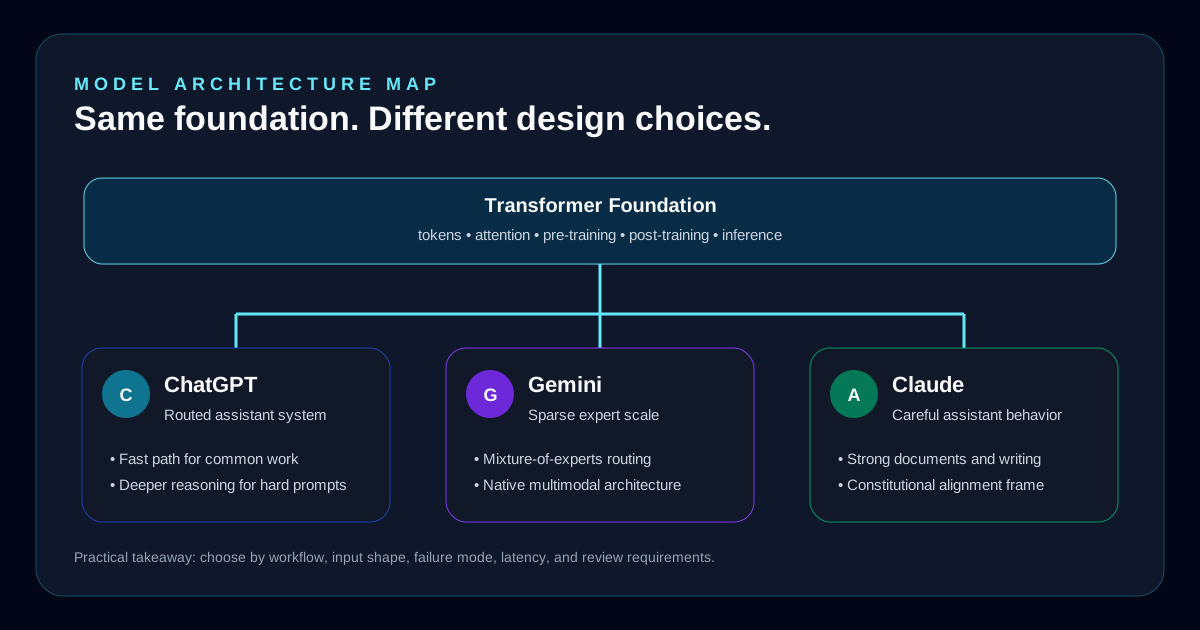
ChatGPT
Often feels like a routed product system: fast answers for common work, deeper reasoning paths for harder prompts, strong tool use, and broad assistant behavior.
Gemini
Often stands out when the input is broad or multimodal: long context, video, images, audio, documents, and Google-style mixture-of-experts scale.
Claude
Often feels careful and text-centered: strong writing, document analysis, high-resolution visual work, long context, and more visible pushback on risky prompts.
Foundation
They start from the same core idea.
ChatGPT, Gemini, and Claude are built on transformer-style neural networks. A transformer reads input as tokens, uses attention to compare each token with the surrounding context, and predicts the next token in the response. Pre-training teaches broad patterns from large datasets. Post-training turns the base model into an assistant that follows instructions, refuses some requests, and tries to be useful.
The important differences come from the system around that foundation. How sparse is the model? How does it handle video or audio? How much context can it hold? How was it aligned? Does it answer immediately, or spend extra compute thinking first?
Density
Scale can be dense, sparse, or routed.
A dense model activates the same broad set of parameters for every token. A sparse mixture-of-experts model has many expert blocks and routes each token to a small subset of them. A product-level router can also send an entire request to a fast model or a deeper reasoning model.
This is why model comparisons are slippery. Two systems may both appear as one chat box, but one may be a single model with adaptive behavior, another may use sparse experts inside the network, and another may route the request across model variants at runtime.
Architecture Map
The practical differences are easier to see by category.
Multimodality and Context
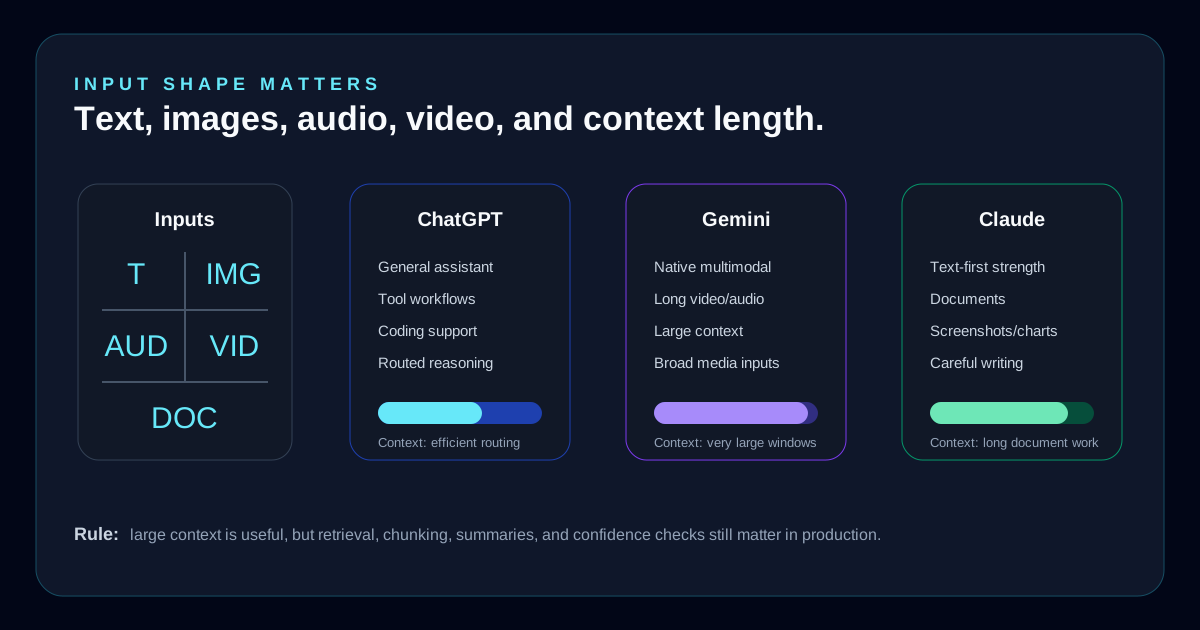
Input shape changes the best tool.
A prompt is not always a paragraph. It might be a codebase, contract set, product video, screenshot, audio clip, support transcript, or technical diagram. Gemini’s native multimodal design makes it strong when many media types are part of the job. Claude is especially useful with dense documents and visual artifacts. ChatGPT is strong as a general assistant with tool workflows, coding help, and reasoning routes.
Long context helps when the answer depends on a lot of raw material. It also costs more and can degrade as the session grows. For production systems, retrieval, chunking, summaries, and confidence checks still matter even when a model supports a large context window.
Alignment
Personality is training made visible.
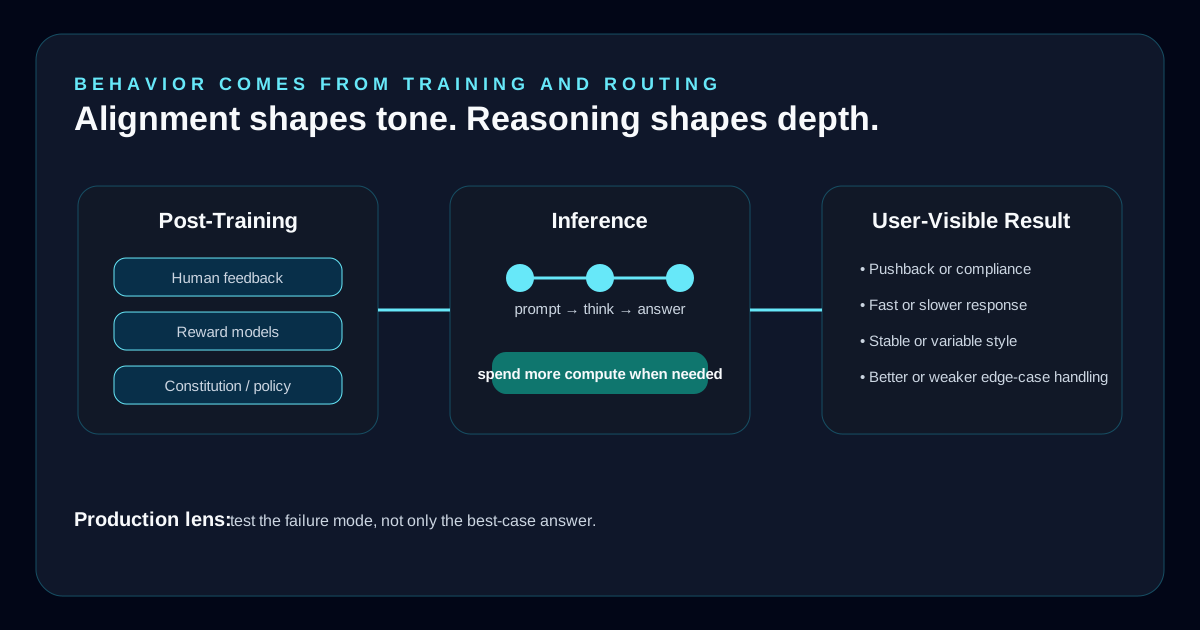
After pre-training, each company shapes the base model into an assistant. Human preference feedback, reward models, written behavior policies, constitutional principles, safety classifiers, and product tuning all affect how the assistant responds.
That is why Claude may push back more often, ChatGPT may move quickly into task completion, and Gemini may vary more depending on domain and media type. These are not just branding differences. They are training and product-design differences.
Reasoning
Hard problems benefit from extra thinking.
A standard chat model starts producing the answer directly. A reasoning model spends extra inference-time compute working through the problem before producing the final response. The user may not see the internal thinking, but the latency, cost, and answer quality can change.
The three systems have converged on the same practical lesson: hard prompts need more compute at response time. They differ in how that compute is selected, surfaced, and integrated with the rest of the assistant experience.
Practical Selection
Choose by workflow, not by brand.
For a real software project, the decision is not which model is smartest in general. The decision is which model fails in the most manageable way for the task in front of you.
Use ChatGPT when
- The workflow needs a general assistant with strong tool use.
- You want fast drafting, coding support, analysis, and operational help in one place.
- The task may need a mix of normal response speed and deeper reasoning.
Use Gemini when
- The input is very large or includes long video, audio, images, and documents.
- The task benefits from native multimodal understanding.
- You need to inspect a broad information set in one pass.
Use Claude when
- The work is document-heavy, writing-heavy, or review-heavy.
- You want careful pushback and a more cautious assistant style.
- The task needs long-form reasoning over dense text, screenshots, policies, or requirements.
Production Risk
The failure mode matters more than the benchmark.
A model that performs well on average may still be dangerous in production if its mistakes are hard to detect. For business software, the safer model is often the one whose behavior can be tested, constrained, monitored, and escalated.
Watch for
- The model gives a confident answer but hides uncertainty.
- The model handles the demo prompt well but fails on edge cases.
- The model accepts too much untrusted context and follows the wrong instruction.
- The model is accurate but too expensive or slow for the production workflow.
- The model behaves differently when the prompt, context length, or media type changes.
HerbDev Perspective
Model choice is an architecture decision.
For client work, I do not start by asking which chatbot is popular this month. I start with the job: what data goes in, what answer comes out, what can go wrong, what the business can afford, and who reviews the result when confidence is low.
The best answer may be ChatGPT, Gemini, Claude, a smaller local model, or a routed system that uses more than one. The point is senior ownership: clear boundaries, observable behavior, practical tests, and a fallback path when the model is uncertain.