Representation and memory · Part 3 of 4
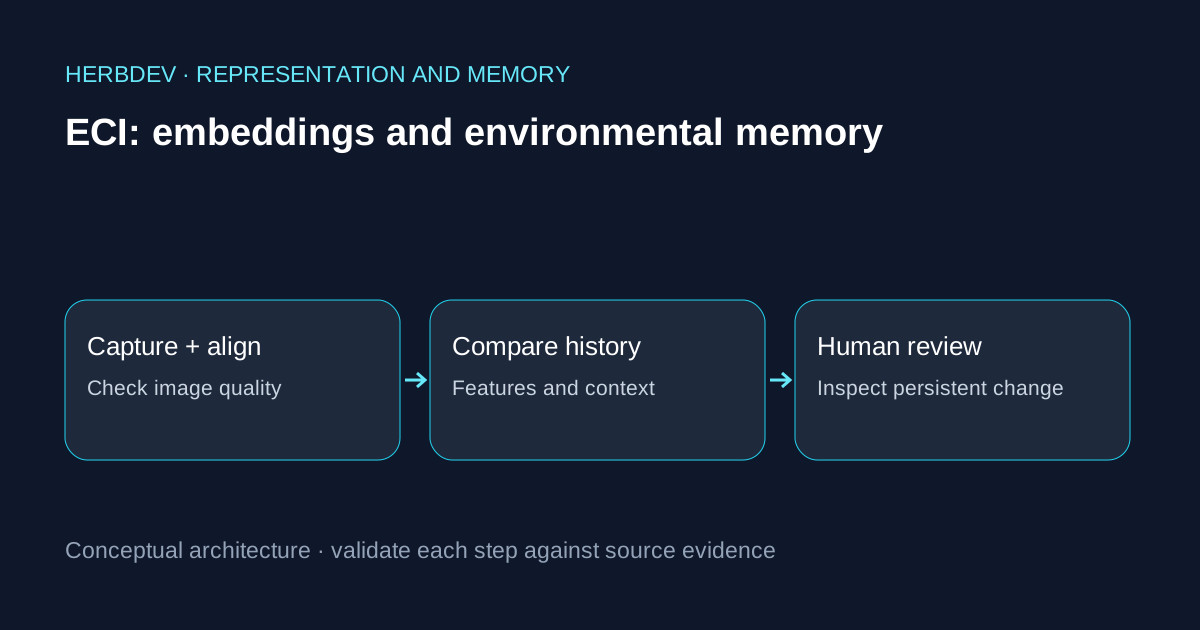
ECI: embeddings and environmental memory
Environmental Change Intelligence, or ECI, is built around a simple observation: the most important information about a physical place often does not exist in a single photograph. It exists in the difference between observations and in the trajectory that develops across time.
A riverbank can retreat gradually. Vegetation can become progressively stressed. A wet area can appear after weeks of dry conditions. A canal edge can deteriorate. A shoreline can move. A one-time image may show the condition, but repeated observations reveal the process.
ECI’s published research platform combines classical and learned evidence with longitudinal history and human review. Field validation remains the next step. Persistent memristor-inspired state is a separate experimental extension, not a demonstrated ECI capability.
Read the narration transcript
Practical Takeaway
Compare the same place through time
How repeated observations, embeddings, context, and human review can build environmental history, with a clear boundary between current ECI and research.
Part 3 · 01
ECI Is More Than Image Classification
A conventional image classifier receives an image and predicts a label. ECI treats the image as an observation tied to location, time, capture conditions, prior observations, and environmental context. The value comes from the relationship between observations rather than only from recognizing what appears in one frame.
- Repeated capture of the same observation point or geographic area.
- Registration so old and new imagery can be aligned.
- Quality scoring to identify blur, exposure, and capture problems.
- Structural and visual change measurements.
- Embeddings or learned features for representation-level comparison.
- Persistence analysis across multiple observations.
- Environmental metadata such as weather and seasonal context.
- Human confirmation or rejection of findings.
- Longitudinal history that becomes increasingly useful as the dataset grows.
Part 3 · 02
What Is an Embedding in ECI?
An embedding is a numerical representation produced by a model. Instead of comparing only raw pixels, ECI can represent an observation in a learned feature space.
The embedding can capture patterns that the encoder learned to consider useful. Depending on the model and training objective, these can relate to shape, texture, object structure, surface conditions, spatial relationships, or other visual characteristics.
Why this helps
Two photographs of the same location can have substantial pixel differences even when nothing important changed. Lighting, shadows, exposure, wind, and small camera shifts create noise. A useful embedding may remain relatively stable across some nuisance variation while changing when the underlying scene changes meaningfully. This does not mean embeddings replace registration or image-quality controls. They add another signal that can be combined with them.
# Compare only compatible, nonzero, normalized feature vectors.
# Fit thresholds on held-out locations and capture conditions.
if current.model_version != baseline.model_version:
    raise ValueError("Re-encode the baseline before comparison")
cosine_distance = 1.0 - dot(current.unit_vector, baseline.unit_vector)
# Distance is a review signal, not a probability or a diagnosis.
Part 3 · 03
A Multi-Signal Change Architecture
Environmental change is too complicated to reduce to one number. ECI can combine independent measurements so that no single fragile signal decides the result.
- Pixel-level change: useful when images are very well aligned.
- Structural similarity: measures broader structural differences.
- Feature matching: verifies whether images correspond to the same physical scene.
- Semantic segmentation: separates water, vegetation, soil, infrastructure, and other regions.
- Embedding distance: compares learned representations.
- Persistence: asks whether a change survives across repeated observations.
- Environmental context: asks whether weather, season, or known activity explains the difference.
- Ground truth: records what a human found when a location was physically inspected.
Part 3 · 04
Visual Memory of the Land
WaterVision, one application of the ECI concept, is designed around building a visual history of physical locations. Repeated observations can establish what normal looks like at a location and make deviations easier to recognize. Over time, the system can learn where water normally appears, how vegetation normally responds, which areas repeatedly erode, and which anomalies tend to become maintenance problems.
Calling this a “visual memory of the land” is useful at the application level. The system remembers because it preserves observations, metadata, analyses, and human verification. That memory can be retrieved and compared later.
Part 3 · 05
Historical Memory Is Not the Same as a Memristor State
This distinction is important. ECI can have memory without having memristor-like state. If the system stores 100 observations for a permanent observation point, it has a valuable historical record. It can compare the latest embedding with previous embeddings, calculate trends, and determine whether a change is persistent.
But the encoder or neural network does not necessarily change merely because observation 100 arrived. The model can remain fixed while the application accumulates more historical data.
Part 3 · 06
Representation Versus Memory
An embedding answers a representation question: “How should this observation be encoded so a machine can compare it with other observations?” A historical database answers a retrieval question: “What did we observe here before?” A persistent state answers a dynamical question: “How has previous activity changed the state through which the next observation will be processed?”
An ECI architecture can derive major value from the first two equations without requiring the third.
Embedding: E(t) = Encoder(Image(t))
Historical comparison: Change(t) = Compare(E(t), E(t-k))
Stateful update: S(t+1) = F(S(t), E(t))
Part 3 · 07
Why ECI Has a Practical Advantage
The key advantage is contextualized change. A generic vision model can say what appears in an image. ECI is designed to determine whether the appearance is normal for that location and time, whether it is changing, whether the change is persistent, and whether the pattern deserves inspection.
That transforms computer vision from isolated recognition into longitudinal observation. The system can prioritize human attention. Instead of asking a worker to inspect an entire property uniformly, it can identify candidate locations that have changed in unusual or persistent ways.
The value of “look here”
For many environmental and infrastructure applications, the AI does not need to autonomously diagnose every problem. A reliable system that reduces hundreds of observations to a small set of credible review locations can create operational value. It allows specialists to spend their limited time on places where evidence suggests something is changing.
Part 3 · 08
Embeddings Can Create Location Signatures
Repeated embeddings can form a learned signature for a particular observation point. The system can estimate the range of representations that are normal under different conditions and then detect observations that fall outside that historical pattern.
A simple implementation might maintain a rolling history of embeddings. A more advanced system could build seasonal clusters, weather-conditioned baselines, or temporal models that learn expected movement through representation space.
Part 3 · 09
Persistence Changes the Meaning of an Anomaly
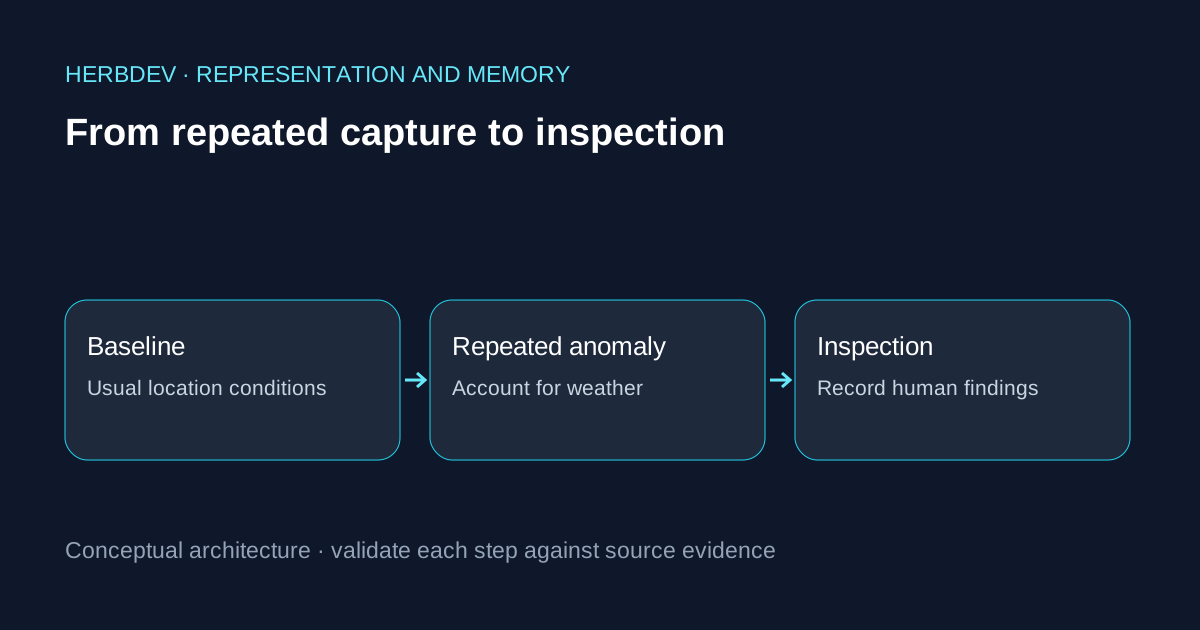
One anomalous image may be caused by a parked truck, shadow, animal, temporary puddle, or capture problem. If a similar anomaly appears at the same location across several well-registered observations, it becomes more important. Persistence converts a momentary difference into evidence of a trend.
These observation counts illustrate persistence; they are not validated alert thresholds. Sampling intervals, registration quality, season, and location-specific evidence determine how many observations are enough.
- One observation: candidate anomaly.
- Two observations: repeated change.
- Three or more observations: potentially persistent condition.
- Growing affected area: possible progression.
- Human confirmation: ground truth that can improve future models.
Part 3 · 10
Environmental Context Reduces False Positives
A wet area appearing after heavy rainfall means something different from the same wet area appearing after a long dry period. Vegetation browning in autumn may be normal while the same pattern in a particular irrigation zone during peak growing season may be unusual. Context matters.
ECI can therefore treat weather, season, location type, sensor measurements, and known maintenance events as evidence that modifies confidence rather than relying on imagery alone.
Part 3 · 11
From Change Detection to Predictive Maintenance
The long-term objective is not merely to flag differences. As a location accumulates history, ECI can begin to characterize rates of change and recurring sequences. A bank that changes slowly for months and then accelerates may deserve a different priority than a one-time disturbance.
- Detect that something changed.
- Determine whether the change is environmental rather than transient.
- Classify the likely type of change.
- Measure persistence, direction, and rate.
- Combine the pattern with historical outcomes.
- Estimate which locations have an increasing probability of requiring intervention.
Part 3 · 12
A Future Stateful ECI Research Direction
A more experimental version of ECI could maintain an evolving computational state for every observation point. The new embedding would not merely be stored; it would update a persistent location state.
That could allow weak repeated evidence to accumulate directly in the model state and irrelevant evidence to decay. It also creates new engineering challenges involving drift, auditability, resets, and validation. This is a future research direction, not a prerequisite for ECI’s current value.
S(location,t+1) = F(S(location,t), E(t), Context(t))
Part 3 · 13
What ECI Is Not Claiming
- An embedding is not a biological memory.
- A vector database is not a simulated synapse.
- Historical observations do not mean the model has consciousness or subjective experience.
- Change detection does not automatically establish the cause of a change.
- The system should recommend inspection rather than make unsupported engineering conclusions.
Part 3 · 14
Conclusion
ECI gains its advantage by combining repeated observation, learned representation, time, context, and human verification. Embeddings make observations easier to compare at a feature level. Historical records create a visual memory of the land. Temporal analysis turns isolated differences into trajectories. Together, these elements allow the system to focus on the question that matters most in environmental monitoring: not simply what is here, but what is changing and whether the change deserves attention.
Keep the distinction clear
An anomaly is a reason to review evidence. It does not establish erosion, a leak, structural failure, or any other physical cause.