Representation and memory · Part 1 of 4
Neuralese: machine-native representation
When people interact with an AI system, the interaction usually happens through human language. We type a sentence, the system returns a sentence, and it can appear as though language is the substance of the computation. In modern neural systems, that is usually not what is happening internally.
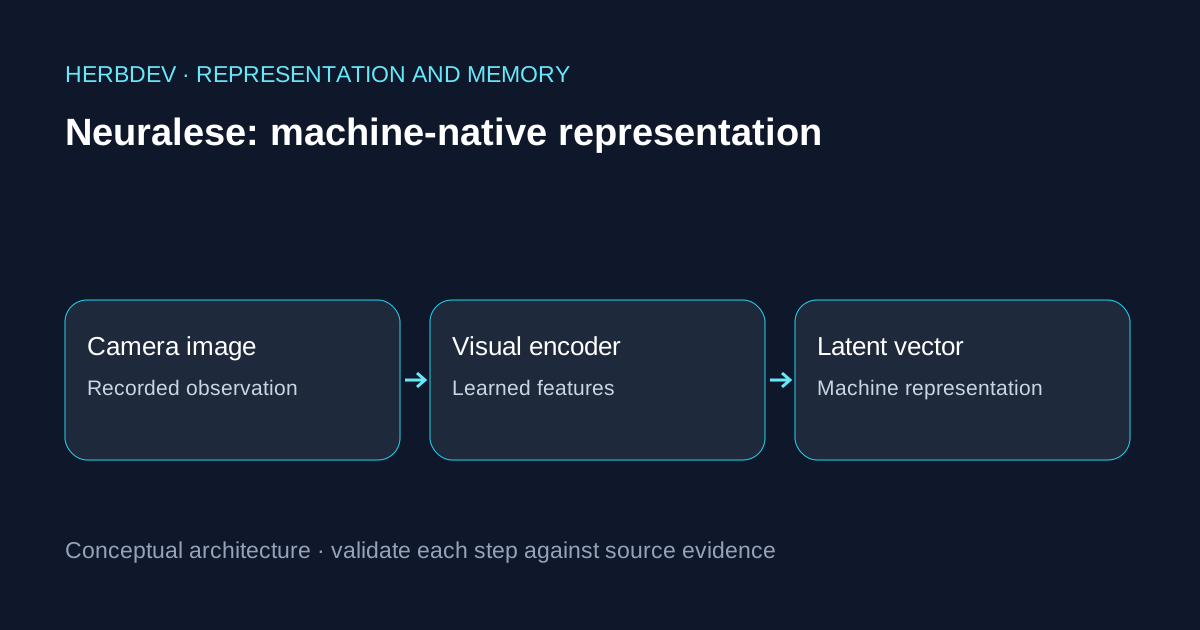
The useful idea behind the term Neuralese is that a machine can operate on learned numerical representations that are native to the model rather than continuously translating every intermediate concept into English, labels, or database fields. Neuralese is not a standardized engineering protocol with a single specification. It is a conceptual way to describe machine-native representation and communication inside neural systems.
Read the narration transcript
Practical Takeaway
Representation carries information
Understand embeddings, latent states, and machine-native communication, and why representation alone does not give an AI system persistent memory.
Part 1 · 01
From Human Language to Mathematical Representation
Suppose a vision system observes a photograph of a canal bank. A human might describe the image using words such as water, vegetation, erosion, soil, shadow, bank slope, and sediment. A neural network does not need to store those words in order to process the scene. It can transform the image into a vector containing hundreds or thousands of learned values.
The vector is not a sentence written in numbers. Information is distributed across the representation. Individual dimensions may not have a simple human-readable definition, yet the full pattern can preserve relationships that are useful for recognition, comparison, prediction, or generation.
Embeddings, latent representations, and hidden states
Several related terms appear in machine learning. An embedding is a learned vector representation used to place information into a mathematical space. A latent representation is an internal representation that captures learned features not directly specified by a human. A hidden state is an intermediate state inside a network or sequence model. These terms overlap, but they are not always interchangeable.
- Embedding: a vector used to represent an item, observation, word, image, location, or other object so that relationships can be measured mathematically.
- Latent representation: a learned internal description of information that may combine many features that are not individually labeled.
- Hidden state: an internal computational state produced as information moves through a model, often reflecting context accumulated during processing.
- Neuralese: a broader conceptual description of allowing learned internal representations to carry meaning inside an AI system without repeatedly converting them to human language.
z = [0.17, -0.62, 0.91, 0.08, ...]
Part 1 · 02
Why Machine-Native Representation Matters
Human labels are useful because people can read them, but labels are also compressions. A classifier that reduces an image to the label “erosion” throws away information about shape, location, texture, severity, context, confidence, and relationships to other features unless those details are separately encoded.
A learned representation can preserve more of that structure. Two observations that differ in lighting but depict the same underlying scene may remain relatively close in representation space. Two observations that look superficially similar but contain a meaningful structural change may move farther apart. This is one reason embeddings and latent features are useful in computer vision, retrieval, anomaly detection, and multimodal systems.
Similarity becomes geometric
Once observations are represented as vectors, similarity can be evaluated mathematically. The system can compare distance, angle, neighborhood, or learned relationships between representations. The goal is not merely to ask whether two files are identical, but whether the model considers them meaningfully related.
similarity(A,B) = compare(embedding(A), embedding(B))
Part 1 · 03
Neuralese Is Not Simply an Embedding
An embedding is one technical mechanism. Neuralese is the larger architectural idea that rich learned representations can remain in machine-native form as they move between stages of computation. A system might create embeddings yet immediately convert them to labels. That system uses embeddings, but it is not fully exploiting the idea of representation-level communication.
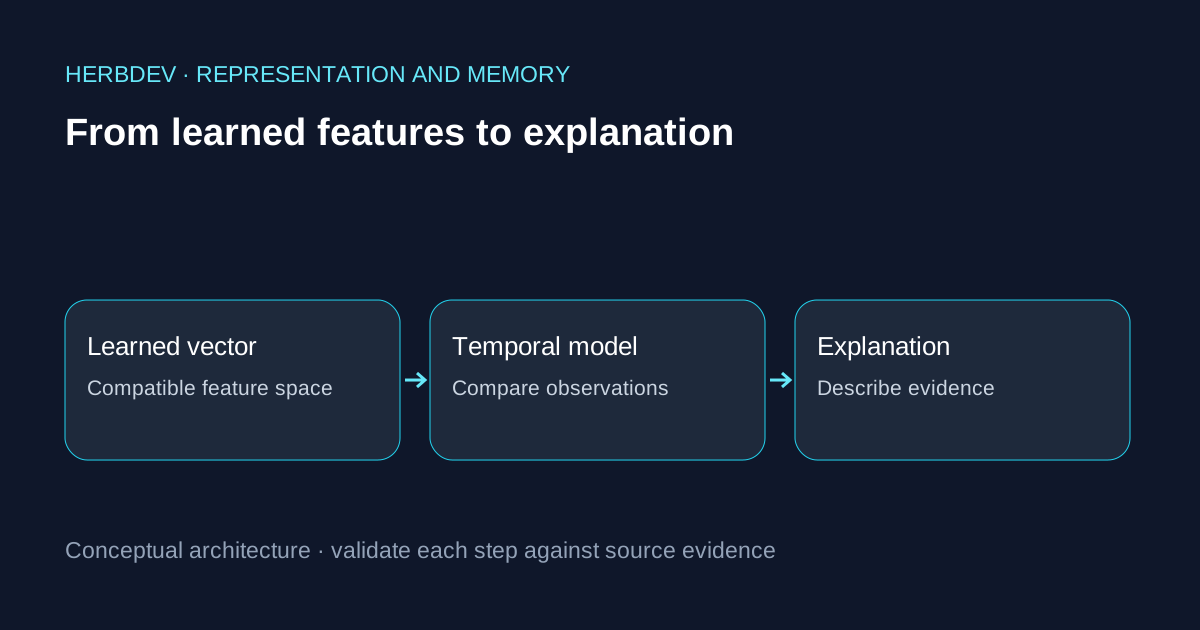
A more Neuralese-like architecture could allow a vision encoder, temporal model, anomaly detector, memory component, and prediction model to exchange learned states directly. Human-readable language would be produced at the boundary where explanation is needed.
Vectors from independently trained models are not automatically compatible. Direct handoffs need a shared encoder, a trained projection, or joint training, together with versioned interfaces and validation. Equal vector dimensions do not establish shared meaning.
Part 1 · 04
An Example Architecture
In this architecture, human language is an interface to the internal system rather than the only format in which the system can carry meaning.
- A camera image enters a visual encoder.
- The encoder creates a high-dimensional representation of the scene.
- A temporal component compares that representation with representations from earlier observations.
- An anomaly component evaluates whether the change is unusual.
- A reasoning or prediction component operates on the combined internal state.
- Only then does a language layer generate a human explanation such as “progressive bank change detected.”
Part 1 · 05
Neuralese and Memory Are Different Concepts
A critical distinction is that representation is not the same thing as memory. A vector can describe an observation without persisting after the computation. A system can also save an embedding in a database, which creates stored history, but that still does not mean the model itself has an evolving memory state.
Part 1 · 06
Neuralese and Language Models
Large language models provide an intuitive example of the distinction. Text is converted into tokens and then into vectors. Layers transform those representations repeatedly. The model does not carry out each internal operation by writing hidden English sentences. Human-readable text appears at the input and output boundaries, while much of the internal computation occurs in learned numerical spaces.
This does not mean that an internal vector has the same properties as a spoken language. The term Neuralese is useful as an analogy, but it should not be used to claim that a neural network has invented a human-like private language unless evidence supports that stronger claim.
Part 1 · 07
Advantages of Representation-Level Communication
- Preserves richer information than a single class label.
- Allows similarity and change to be measured in learned feature space.
- Can connect specialized models without forcing every handoff through English.
- Can retain ambiguity and uncertainty that would be lost in a hard label.
- Supports multimodal reasoning across images, sensor readings, text, and other data.
- Can reduce dependence on manually designed taxonomies when the model can learn useful features directly.
Part 1 · 08
Limitations and Engineering Risks
Machine-native representations are powerful precisely because they are compressed and distributed, but that makes them difficult to interpret. A vector may be useful without providing a simple explanation of what each dimension means. Representations can also encode irrelevant correlations, dataset bias, camera artifacts, or other shortcuts.
For applied systems, Neuralese-like processing should therefore be paired with validation, explainability, traceable source observations, uncertainty estimates, and human review where decisions matter.
Part 1 · 09
Connection to Environmental Intelligence
Environmental Change Intelligence can benefit from this idea because environmental observations contain far more information than a single label. A photograph of a riverbank may contain geometry, vegetation condition, moisture evidence, sediment patterns, surface texture, shadows, human activity, and seasonal cues. Embeddings provide a way to represent some of those relationships compactly.
A future ECI system can use representation-level comparison to complement image registration, structural change detection, environmental metadata, and temporal history. The system can ask not only whether pixels changed, but whether its learned representation of a location changed in a meaningful way.
Part 1 · 10
What Neuralese Does Not Mean
- It does not automatically mean the AI has long-term memory.
- It does not imply consciousness or self-awareness.
- It is not the same as a vector database.
- It is not a synonym for an embedding, although embeddings can be part of the architecture.
- It does not prove that internal representations correspond to words or thoughts the way human language does.
Part 1 · 11
Conclusion
The practical importance of Neuralese is not the name. It is the architectural principle behind it: machines can retain and transform rich learned representations without reducing every intermediate step to human language. That makes it possible to build systems in which vision, temporal analysis, memory, prediction, and reasoning interact through representations designed by learning rather than exclusively through labels designed by humans.
Keep the distinction clear
A representation can be temporary. Saving it creates history; changing a persistent computational state is a separate design choice.