Computer Vision
iOS Vision Framework vs Android computer vision.
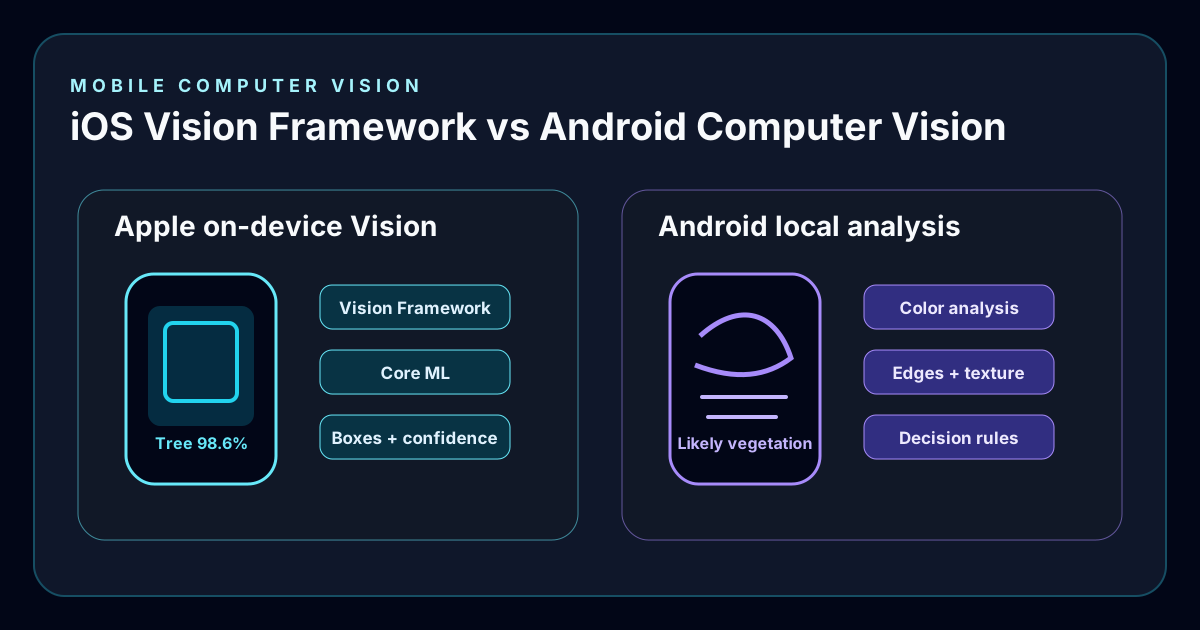
Apple and Android can both run computer vision locally. The difference is usually the stack, the default tools, and the implementation choice. Apple's Vision Framework gives iOS developers a very strong first-party path for on-device analysis. Android can reach similar outcomes with TensorFlow Lite, MediaPipe, ML Kit, NNAPI, GPU acceleration, CameraX, and OpenCV.
This guide explains the practical difference between neural-network inference and heuristic local analysis, using OrganicVision as the example research platform.
Read the narration transcript
Plain-English Summary
This is not iOS good, Android bad.
It is a comparison between a rich first-party Apple vision stack and a specific Android implementation that may choose heuristics for compatibility, simplicity, speed, or resource control. Android can run real AI locally. Heuristics are a design decision, not a platform ceiling.
1. Platform Statement
What does this statement mean?
"iOS has richer on-device Vision analysis; Android uses heuristic local analysis."
That sentence describes the capabilities being used in a particular application design. It does not mean Android cannot run AI. It means the iOS build may be using Apple's Vision Framework and Core ML for learned computer vision inference, while the Android build may be using handcrafted local rules.
The distinction matters because the outputs are different. A neural vision pipeline can say, "this looks like a tree with 98.6% confidence," because it has learned patterns from examples. A heuristic pipeline may say, "this region is mostly green, tall, rough, and irregular, so it is likely vegetation." Both are local. Both can be useful. They are not the same kind of analysis.
2. Apple Stack
What Apple provides.
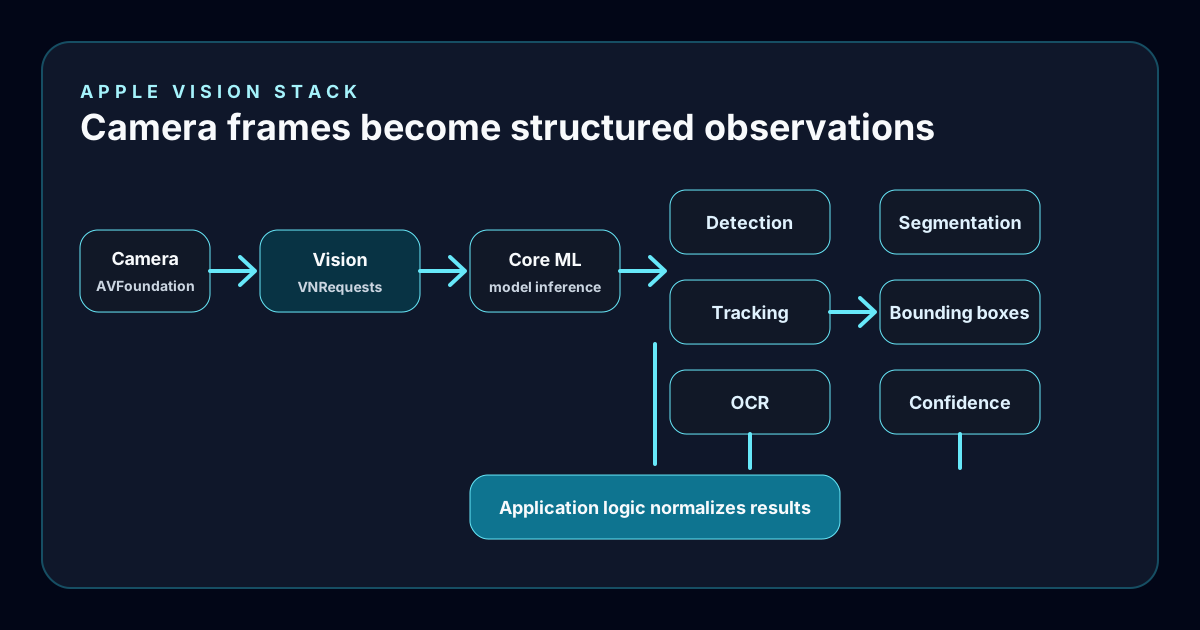
Apple gives iOS developers a tightly integrated set of frameworks for on-device AI. The practical benefit is not just that a model can run locally. The benefit is that the camera, image pipeline, ML runtime, hardware acceleration, and app APIs are designed to work together.
For a mobile computer vision application, this can reduce integration friction. A developer can capture frames, send them through Vision requests, use Core ML models, track observations across frames, and return structured results without building every piece from scratch.
Vision Framework
High-level image analysis APIs for object detection, tracking, OCR, face landmarks, barcodes, image registration, feature prints, segmentation-style tasks, and Core ML model requests.
Core ML
The model runtime that packages trained machine-learning models and runs inference locally on Apple hardware.
Metal
The low-level graphics and compute layer that helps accelerate work on the GPU where appropriate.
Create ML
Apple's training and model-building tooling for teams that need custom classifiers or detectors.
Natural Language Framework
Local language APIs that can pair with vision features when image understanding needs labels, text, or lightweight classification.
Accelerate
A performance framework for vector, matrix, image, and signal operations that can support lower-level computer vision work.
3. Android Stack
What Android can do.
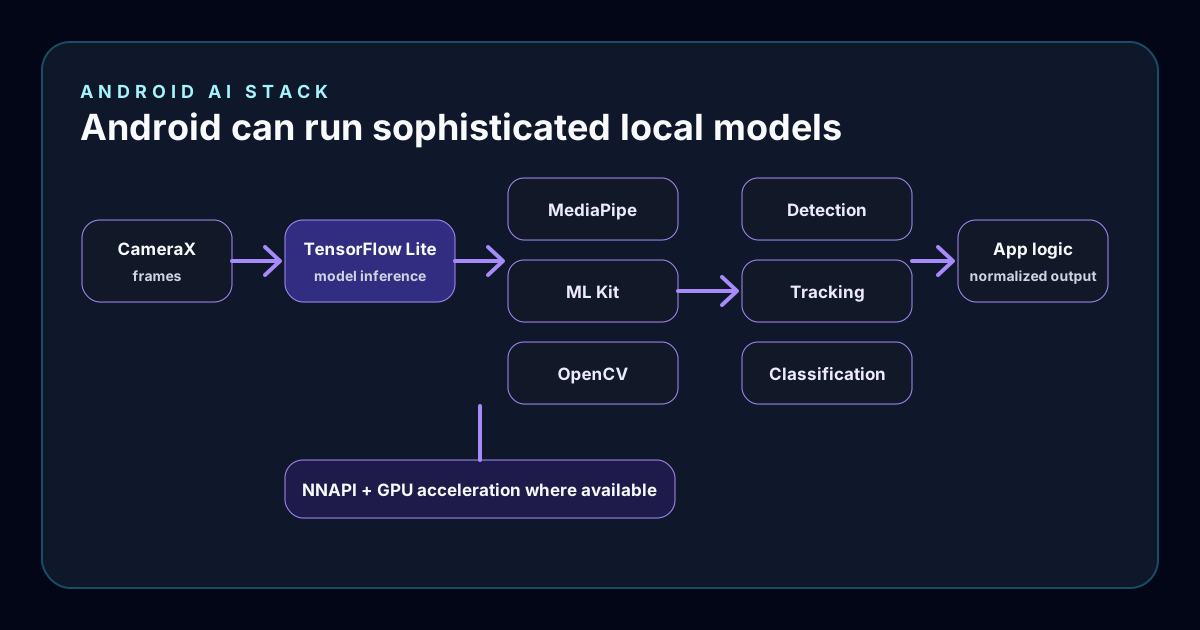
Android is fully capable of sophisticated on-device AI. A production Android vision app can use TensorFlow Lite for local inference, MediaPipe for real-time perception pipelines, ML Kit for common mobile vision tasks, CameraX for frame capture, NNAPI and GPU delegates for acceleration, and OpenCV for classical image processing.
If an Android project uses heuristics instead of a model, that is usually a product or engineering decision. The team may be supporting older devices, reducing memory use, avoiding model packaging, speeding up a prototype, or keeping behavior deterministic.
TensorFlow Lite
A local inference runtime for mobile and embedded machine-learning models.
MediaPipe
A framework for real-time perception pipelines such as pose, hand, face, object, and multimodal processing.
Google ML Kit
Mobile-ready APIs for common vision and language tasks such as text recognition, barcode scanning, image labeling, and face detection.
NNAPI
Android's Neural Networks API for delegating supported model operations to device accelerators.
GPU acceleration
A way to move supported inference or image-processing work onto graphics hardware when the device and model allow it.
CameraX
A modern Android camera library that simplifies preview, capture, analysis streams, and lifecycle behavior.
OpenCV
A widely used computer vision library for image processing, contours, edges, geometry, and classical CV features.
Implementation Examples
The code shape is different even when the product goal is the same.
A real production app needs camera lifecycle handling, threading, memory control, error handling, result smoothing, frame throttling, model versioning, and privacy review. The examples below are intentionally small. They show the architectural difference: iOS often wraps model execution inside Vision requests, while Android may call a TensorFlow Lite interpreter, an ML Kit detector, a MediaPipe graph, or a handcrafted image-processing pipeline.
Swift: Vision request with a Core ML model
The iOS path often starts with a Core ML model wrapped in a Vision request. Vision handles image orientation, request execution, and observation objects. The application receives structured observations and maps them into its own domain model.
let model = try VNCoreMLModel(for: TreeDetector().model)

let request = VNCoreMLRequest(model: model) { request, error in
    guard error == nil else { return }

    let observations = request.results as? [VNRecognizedObjectObservation] ?? []
    let detections = observations.map { observation in
        VisionDetection(
            label: observation.labels.first?.identifier ?? "Unknown",
            confidence: observation.confidence,
            boundingBox: observation.boundingBox
        )
    }

    publishNormalizedResults(detections)
}

let handler = VNImageRequestHandler(cvPixelBuffer: frameBuffer)
try handler.perform([request])
Kotlin: local model output mapped to the same contract
The Android path may use TensorFlow Lite directly or through a higher-level library. The important architecture decision is not the exact wrapper. It is that Android produces the same normalized output fields as iOS.
val input = preprocessCameraFrame(imageProxy)
val output = Array(1) { Array(maxDetections) { FloatArray(6) } }

tfliteInterpreter.run(input, output)

val detections = output[0]
    .filter { row -> row[4] > 0.70f }
    .map { row ->
        VisionDetection(
            label = labels[row[5].toInt()],
            confidence = row[4],
            boundingBox = RectF(row[0], row[1], row[2], row[3])
        )
    }

publishNormalizedResults(detections)
The shared contract is the product boundary.
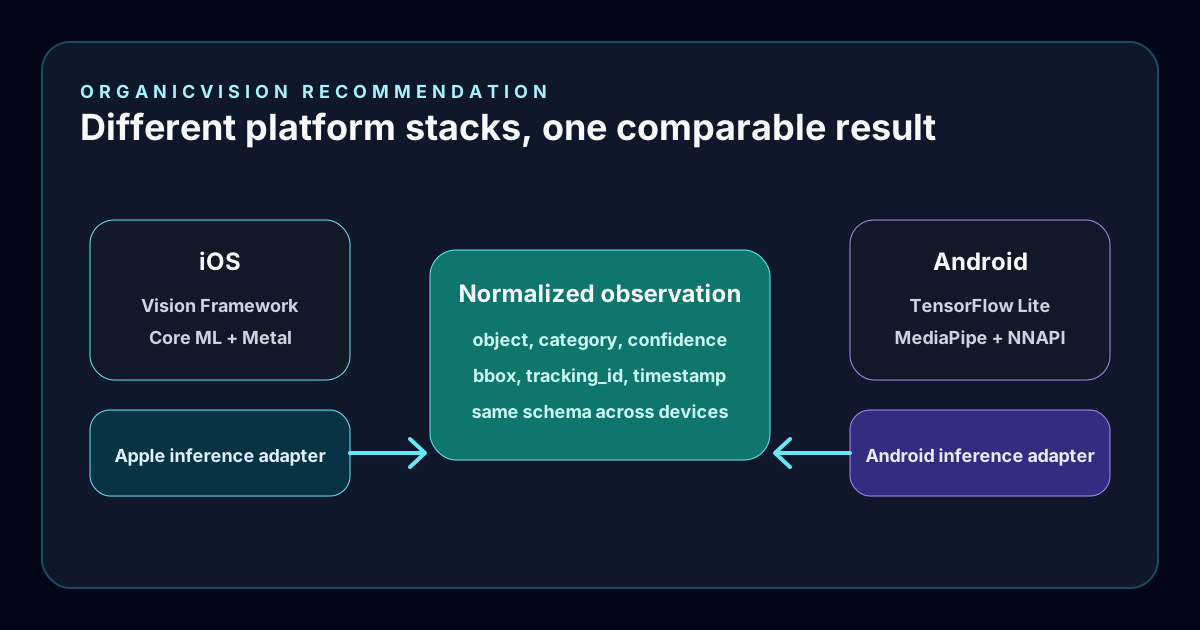
The iOS implementation can be very Apple-native. The Android implementation can be very Android-native. The business layer should not care whether the observation came from Vision, Core ML, TensorFlow Lite, MediaPipe, ML Kit, OpenCV, or a temporary heuristic classifier. It should receive a stable object: label, category, confidence, bounding box, tracking identifier, source platform, model version, timestamp, and review status.
That boundary is what keeps a research platform honest. If iOS stores rich neural detections and Android stores loose text notes, the datasets cannot be compared without cleanup. If both platforms produce the same observation schema, the research team can compare accuracy, speed, battery use, confidence, false positives, false negatives, and human review outcomes across devices.
4. Heuristic Analysis
What is a heuristic?
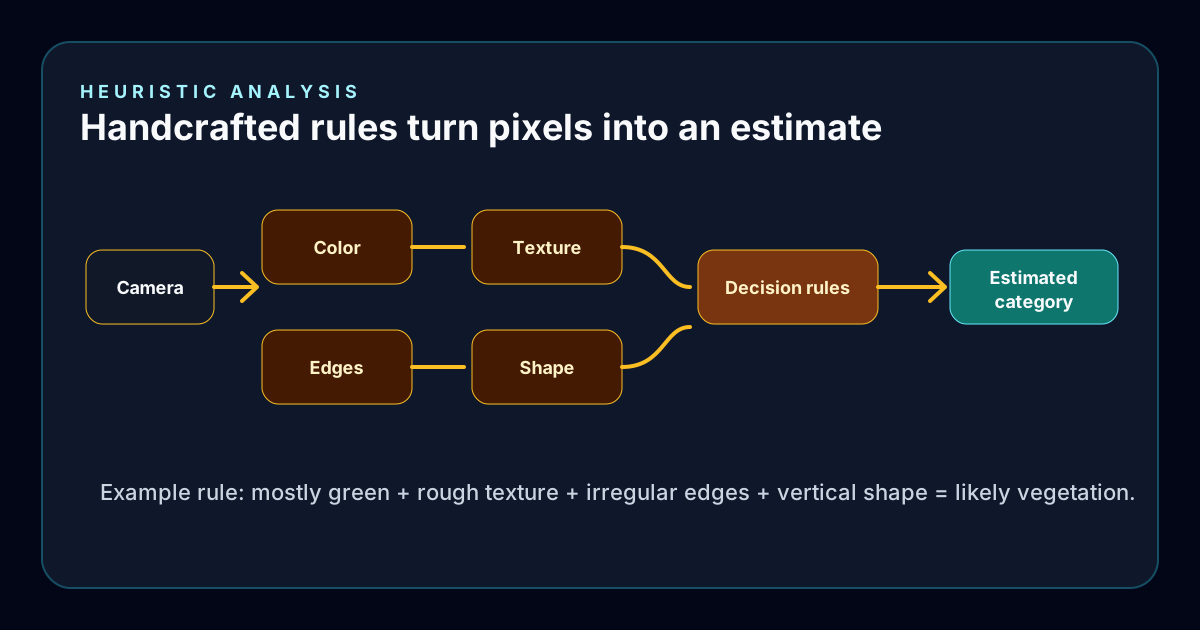
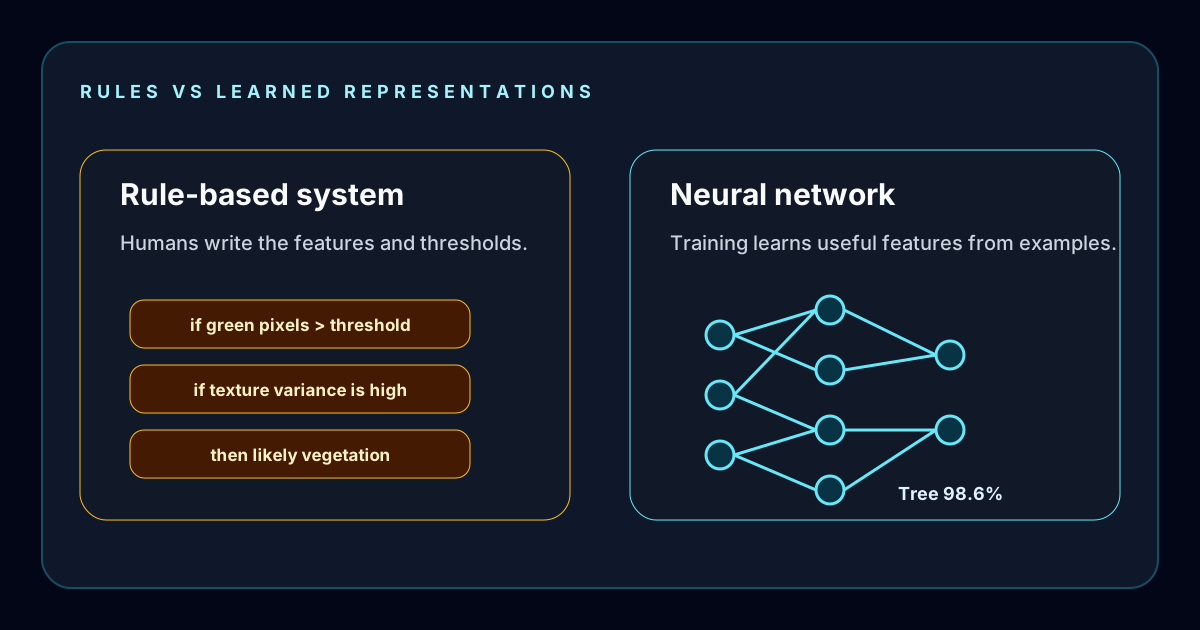
A heuristic is a practical rule. In computer vision, a heuristic pipeline looks for features a developer defines ahead of time: color, edges, texture, shape, brightness, movement, or size. The software does not learn the concept of "tree" from examples. It checks measurements and applies rules.
This can work well when the environment is controlled and the categories are simple. It breaks down when real-world variation gets wider than the rules anticipated.
5. Neural Networks
Neural networks learn features instead of relying only on handcrafted rules.
A neural network is trained on examples. During training, it sees many labeled images and adjusts internal weights until it can recognize patterns that help predict the correct label. During inference, the app sends a new image through the trained model and receives predictions, confidence scores, bounding boxes, segmentation masks, embeddings, or other structured outputs.
The important difference is generalization. A well-trained model can recognize a tree it has never seen before because it learned a representation of tree-like visual features. It is still imperfect, and it can still be wrong, but it is not limited to a small list of developer-written thresholds.
Training and inference are different jobs.
Training usually happens before the mobile app ships. Inference happens inside the app when the user points the camera, records a video, imports an image, or runs an analysis. A mobile app normally packages an optimized model for inference, not the whole training system.
6. Practical Example
One tree, two different output styles.
Imagine both apps see the same tree. The iPhone implementation may send the camera frame through Vision and a Core ML model. The output can include an object label, a confidence score, a bounding box, and a tracking identifier. A heuristic engine may not know the label "tree." It may only know the region is green, vertical, irregular, and textured.
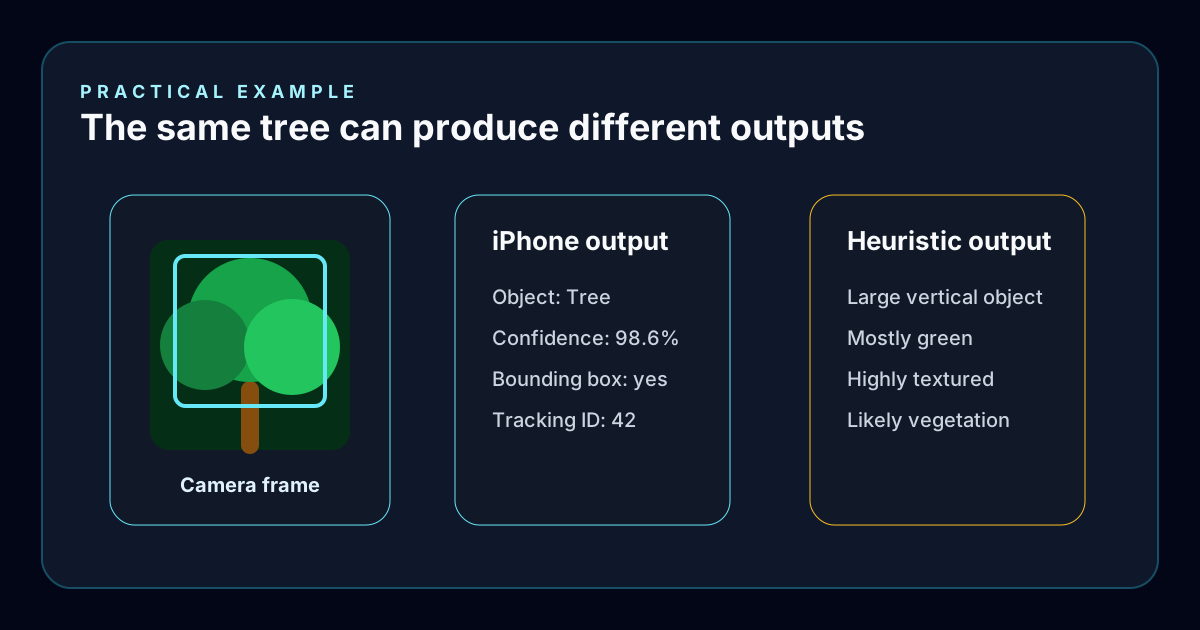
Neural output
{
  "object": "Tree",
  "confidence": 0.986,
  "bbox": [123, 45, 300, 512],
  "tracking_id": 42
}
Heuristic output
{
  "estimate": "Likely vegetation",
  "features": ["mostly_green", "rough_texture", "irregular_edges"],
  "confidence": "medium"
}
7. Tradeoffs
Advantages and disadvantages.
The right approach depends on the project. A neural pipeline is usually better for recognition, generalization, and research comparability. A heuristic pipeline can be faster to prototype, easier to run on constrained devices, and more predictable when the rules are narrow.
The comparison should be measured, not guessed.
For a serious mobile vision project, the team should keep a small evaluation set that includes ordinary examples, difficult examples, low-light examples, motion blur, partial objects, confusing backgrounds, and known false positives. Each platform should process the same set. The results should be reviewed by humans and stored with the model version, device model, OS version, and processing time.
That gives the team a practical way to decide whether a neural pipeline is worth the added complexity, whether a heuristic is good enough for a narrow feature, and whether one platform is drifting away from the other. Without evaluation data, architecture discussions turn into opinions. With evaluation data, the team can make a release decision.
8. Design Decision
Why projects sometimes use heuristics.
Heuristics still make sense in real software. They are not obsolete. They are useful when the team needs simple, deterministic behavior and the input conditions are known.
When does a heuristic become a maintenance problem?
When every new user report requires another rule, threshold, exception, or device-specific branch, the heuristic system starts behaving like hidden technical debt. At that point, a small model, a hybrid model-plus-rules architecture, or a better data collection process may be the cleaner path.
A heuristic can also be a bridge.
Early in a research product, a heuristic can help define the measurement problem before the team invests in training data. If the team cannot describe useful rules, it may not yet understand the domain well enough to label examples. In that sense, heuristics can be a discovery tool. They force the team to name the visual signals it cares about: color, edge density, motion, shape complexity, texture, size, location, or temporal behavior.
The danger is leaving the bridge in place after the project needs a more general solution. A prototype rule like "green plus vertical means vegetation" may help prove a demo, but it will struggle with winter trees, desert plants, painted walls, green signs, artificial turf, shadows, and camera exposure changes. The more varied the real world becomes, the more the system needs learned visual representations and a review process.
9. OrganicVision Recommendation
Use AI-based inference on both platforms, then normalize the output.
For OrganicVision research, iOS and Android should ultimately produce comparable observations. That does not require identical internal frameworks. It does require the same output contract, the same evaluation logic, and comparable test data.
On iOS, the natural stack is Vision Framework, Core ML, and Metal. On Android, the natural stack is TensorFlow Lite, MediaPipe, NNAPI, and GPU acceleration where available. Both should map results into the same normalized schema.
Recommended normalized output
{
  "object": "Tree",
  "category": "Organic",
  "confidence": 0.986,
  "bbox": [123, 45, 300, 512],
  "tracking_id": 42
}
object
The detected label.
category
The research category.
confidence
The model's score.
bbox
The image region.
tracking_id
The object identity across frames.
For research, the schema should also carry metadata that does not appear in the small example: platform, device model, OS version, app version, model version, frame timestamp, image source, processing mode, and whether a human reviewer confirmed the result. Those fields are not busywork. They let the team explain why one device behaves differently from another and whether a model update improved or damaged real performance.
10. Future Improvements
The platform can become more capable without losing comparability.
The next stage is not just better labels. A stronger research platform can understand regions, instances, depth, motion, persistence, and scene context. The key is adding capability through normalized outputs and measured evaluation, not through unrelated one-off platform behavior.
Related Reading
Computer vision decisions connect to architecture, model strategy, and maintenance ownership.
HerbDev Perspective
Use the platform tools, but standardize the result.
For mobile AI research and production apps, the best architecture usually lets each platform use its strongest native tools while keeping business logic, evaluation, storage, and reporting consistent. That is how a cross-platform AI product stays practical instead of becoming two unrelated experiments.