Baseline
The baseline is the starting model. It establishes what the simplest defensible approach can do before optimization.
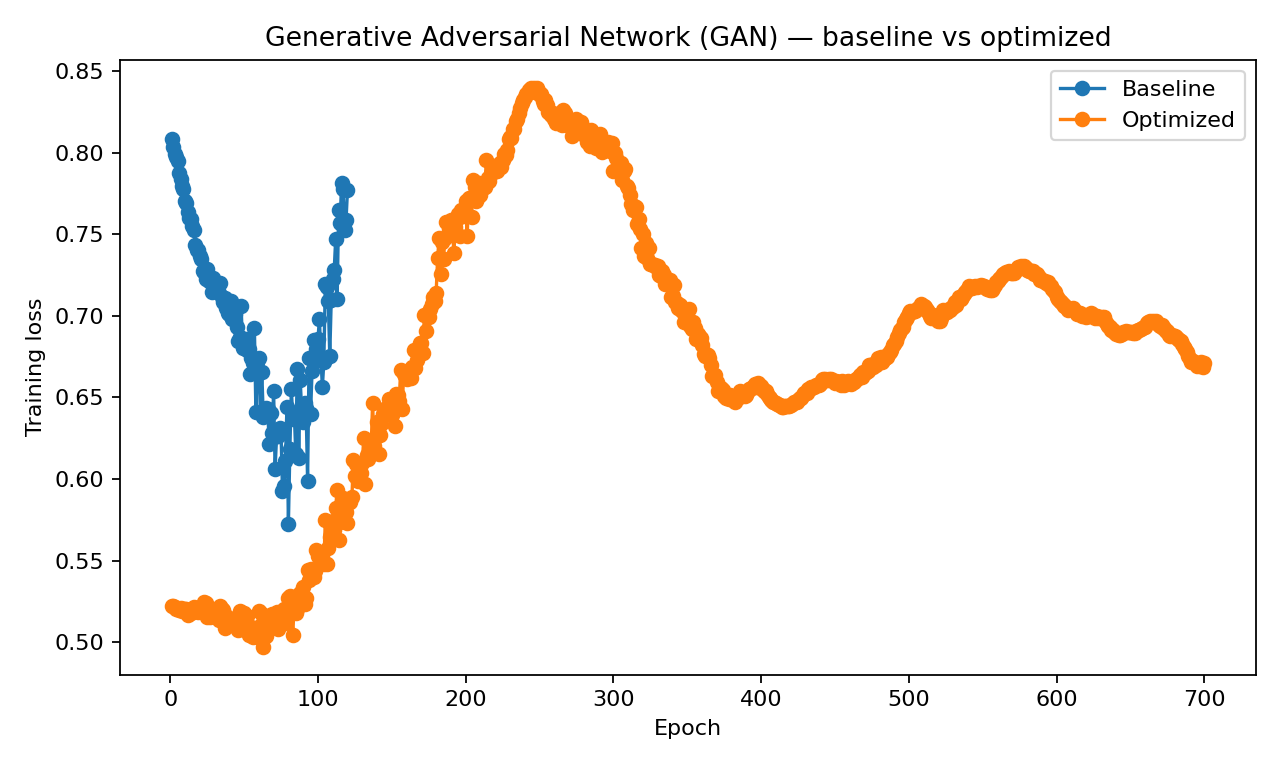
Trains a generator and discriminator together, making stability and diagnostics central to the workflow. This proof of concept shows not only the final model, but the optimization path used to get there.
A useful model-development engagement starts with evidence. This repository establishes a baseline, records its behavior, makes one documented optimization, reruns the model, and preserves the results so the decision can be explained and reproduced.
| Generated Mean | 3.20711 |
|---|---|
| Target Mean | 2.0 |
| Mean Error | 1.20711 |
| Generated Std | 1.3094 |
| Target Std | 0.6 |
| Train Seconds | 0.37638 |
The baseline adversarial game was unstable. Lower the learning rate, increase capacity, and give both networks more update steps before judging distribution fit.
| Generated Mean | 1.95252 |
|---|---|
| Target Mean | 2.0 |
| Mean Error | 0.04748 |
| Generated Std | 0.61628 |
| Target Std | 0.6 |
| Train Seconds | 1.34144 |
The baseline is the starting model. It establishes what the simplest defensible approach can do before optimization.
Validation data is held out from training and used to compare decisions without tuning against the final test set.
The test score is the final check on untouched data. It estimates whether the improvement generalizes beyond examples used to guide development.
Training seconds show the compute tradeoff in this small experiment. Production cost also depends on data volume, hardware, model size, monitoring, and retraining frequency.
Important: These synthetic datasets make the engineering process reproducible; their scores are not claims about performance on a client's real data.
Set the objective, success metric, data assumptions, deterministic split, and reproducibility seed.
Train a modest reference model and inspect loss, validation behavior, architecture capacity, and failure mode.
Choose a controlled change for a documented reason, retrain, and compare against held-out validation data.
Run untouched testing, generate evidence artifacts, document limitations, and identify production implications.
The synthetic dataset is replaced by governed source data. The same workflow expands to include leakage checks, stronger domain baselines, experiment tracking, class-imbalance strategy, model registry/versioning, appropriate explainability, acceptance thresholds, drift monitoring, security controls, deployment, and rollback.
A productive first review focuses on the current baseline, data quality, error patterns, operational constraints, and the metric that matters to the business. That is usually more informative than immediately increasing model size or compute.
“Remove my test data” clears all AI 101 and ML 101 scores, reviews, project checklists and rating selections, plus saved vocabulary and recent history in this browser. Test entries cannot be separated from other learning progress. Cookie preferences, security protections, submitted feedback, contact emails and past analytics are kept.