Problem
A claim may require different expertise and evidence depending on the item, coverage, repair history, price, and anomaly signals. A useful system must organize that context without hiding uncertainty or accountability.
Architecture Example
This architecture example shows how an AI-assisted claims process could route a submission, gather decision context, record confidence, and require review rather than treating model output as an automatic business decision.
A claim may require different expertise and evidence depending on the item, coverage, repair history, price, and anomaly signals. A useful system must organize that context without hiding uncertainty or accountability.
Policy rules, historical data, pricing, parts availability, fraud signals, and customer records may be incomplete or conflict. Decisions need traceability, access controls, validation, and escalation to an authorized person.
Normalize the submission, classify it into a specialized workflow, retrieve permitted decision context, compare repair and replacement paths, calculate confidence, log the basis for the recommendation, and route uncertain or consequential cases to human review.
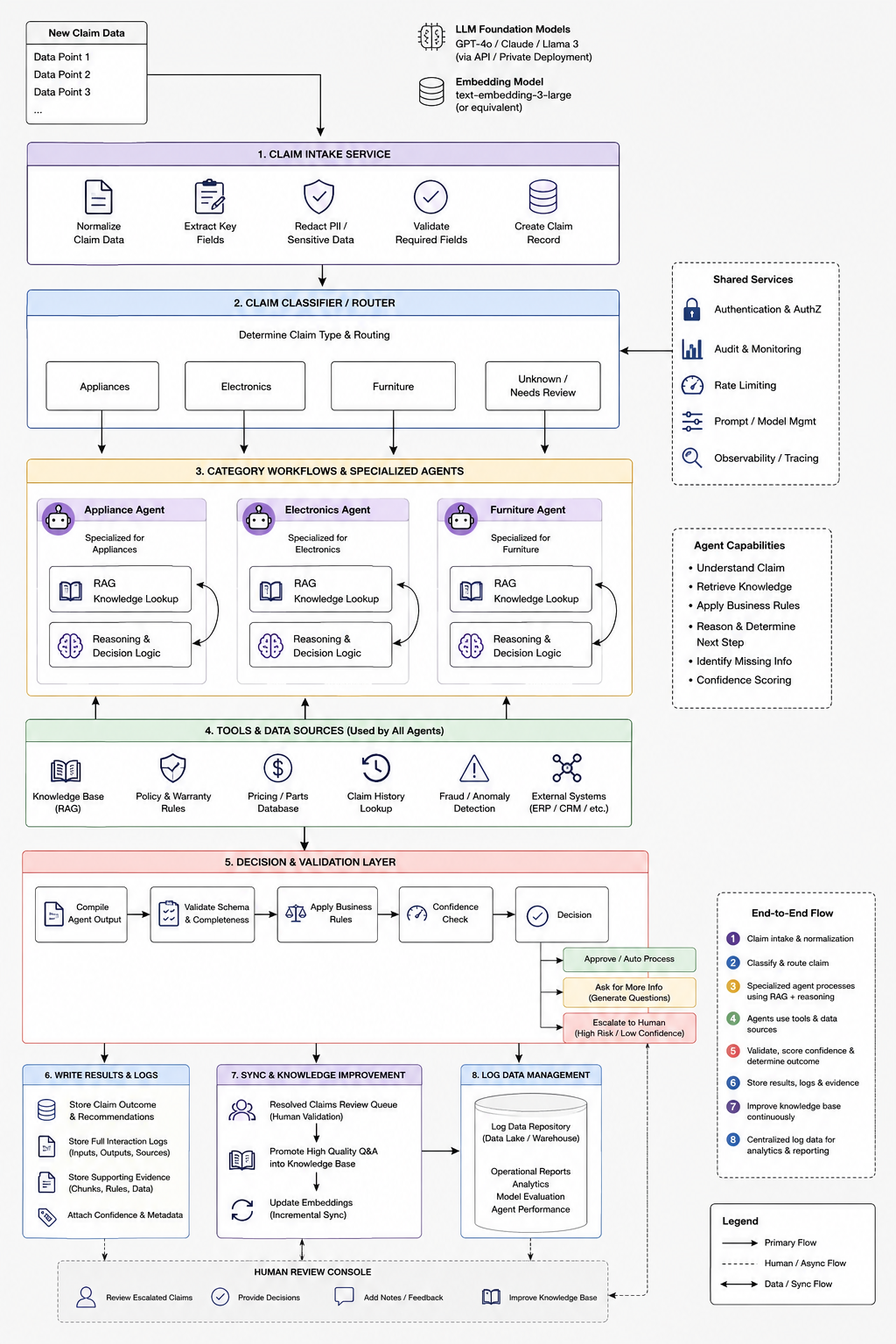
This example is intentionally self-contained. There is no underlying client project or private deployment being implied.
HerbDev can help define the data, review boundaries, confidence handling, integrations, and validation plan before automation becomes operational risk.
Discuss a Similar Workflow“Remove my test data” clears all AI 101 and ML 101 scores, reviews, project checklists and rating selections, plus saved vocabulary and recent history in this browser. Test entries cannot be separated from other learning progress. Cookie preferences, security protections, submitted feedback, contact emails and past analytics are kept.