AI Inference Hardware
GPUs Just Lost the Token Race
The AI hardware conversation used to be simple: more GPUs, more parallel math, more progress. That is still a reasonable answer for training. It is no longer the whole answer for serving a model to real users.
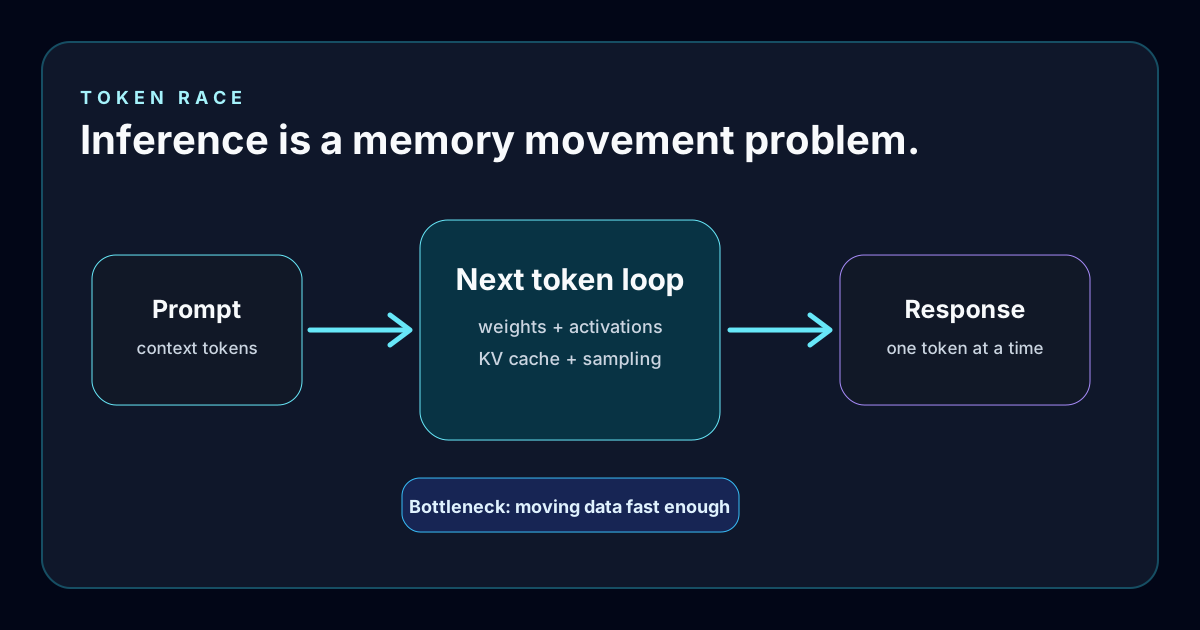
When an app is generating text, code, or speech, the system is doing a tight repeated operation. It reads the prompt context, consults model weights, updates attention state, chooses the next token, and repeats. The user experiences that loop as speed, delay, or awkward pauses.
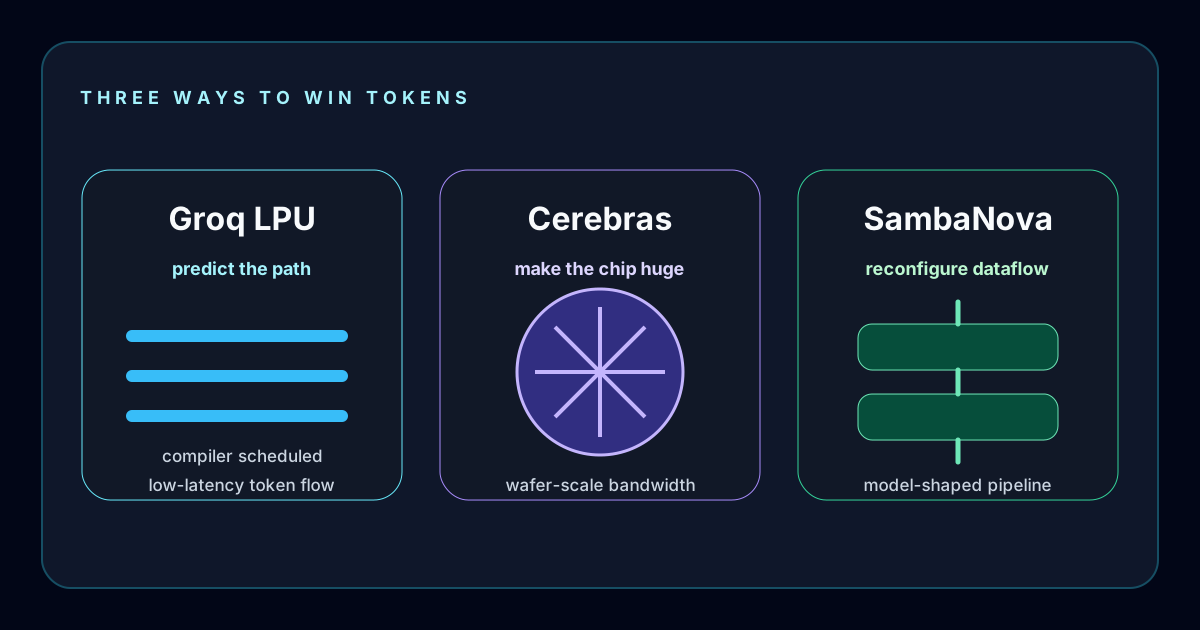
The new inference race is about how efficiently a system can keep that loop supplied with data. Groq, Cerebras, and SambaNova are important because each one changes the path data takes through the machine.
Read the narration transcript
Practical Takeaway
Inference speed is now an architecture decision.
GPUs are still useful, flexible, and widely supported. The shift is that production inference has different pressure than training. A live voice agent, a long-context research assistant, and a high-volume API need predictable latency, memory locality, and cost control. Specialized accelerators are gaining ground because they start with those constraints instead of treating them as afterthoughts.
Inference Reality
Serving a model is not the same problem as training one.
Training rewards flexibility and massive parallelism. You push huge batches through the model, adjust weights, and spread the work across a large cluster. GPUs are extremely good at that style of work.
Inference has a different shape. The model is already trained. Now the system has to answer quickly, repeatedly, and economically. The hard part is keeping the right data close to compute while the model steps through one token after another.
This is why inference hardware is becoming its own category. The winners are not just the chips with the biggest math numbers. They are the systems that reduce stalls, memory trips, synchronization overhead, and unpredictable latency.
Training and inference are becoming different markets.
A team may train or fine-tune on one kind of infrastructure and serve users on another. That split is normal. The serving layer should be chosen around latency, context length, throughput, reliability, and cost per useful answer.
Groq
Groq is focused on predictable, low-latency inference.
Groq's Language Processing Unit is designed for a narrow and valuable job: run language-model inference with highly predictable timing. The system relies on compiler-planned execution instead of leaving scheduling decisions to a more dynamic runtime.
That approach matters when the product is conversational. A user can tolerate a model thinking for a moment before a long answer. They notice much more when a voice assistant hesitates between short phrases or when a chat interface emits tokens unevenly.
The practical value is consistency. Groq is not trying to be the most flexible accelerator for every AI workload. It is trying to make the token loop fast enough and regular enough for interactive products.
Best fit
Interactive assistants, voice workflows, live support tools, and products where response rhythm affects trust.
Architecture idea
Plan the work ahead of time so data movement and execution order are more predictable.
Buyer caution
The advantage depends on supported models, deployment path, and whether the workload really needs ultra-low latency.
Cerebras
Cerebras reduces the cost of spreading work across machines.
Cerebras starts from a different problem: large models often become distributed-systems projects. The more a workload has to coordinate across devices and servers, the more performance is lost to communication, orchestration, and memory movement.
The Wafer-Scale Engine changes the packaging decision. Instead of making many smaller chips behave like one system, Cerebras puts a very large amount of compute and memory communication on a single wafer-scale device.
For teams working with large models or long contexts, that design can simplify a painful part of inference: keeping enough of the model's working state close enough to compute that the system does not spend all day waiting on itself.
Best fit
Large-model inference, long-context processing, research environments, and high-throughput data-center deployments.
Architecture idea
Put more compute and communication fabric together so large workloads require fewer external hops.
Buyer caution
This is infrastructure, not a simple card purchase. It belongs in serious capacity planning.
The wafer is the architecture.
Cerebras is making a packaging argument as much as a chip argument: if the workload wants one enormous machine, build something closer to one enormous machine.
SambaNova
SambaNova treats inference as a dataflow pipeline.
SambaNova's Reconfigurable Dataflow Unit is built around the idea that the model should shape the machine's execution path. The software maps the workload onto a dataflow pattern instead of forcing every model through the same general pipeline.
That is useful because real inference is not one uniform operation. The system may process a long prompt, run attention, decode tokens, route between models, or serve many customer requests at once. Different stages create different pressure on memory and compute.
The SambaNova pitch is strongest at the system level. It is less about one flashy single-user demo and more about keeping enterprise inference efficient when context windows are large, workloads vary, and cost matters.
Best fit
Enterprise AI platforms, long-context workflows, multi-model serving, and workloads with mixed request patterns.
Architecture idea
Let the model and software define the data movement path so the pipeline wastes less time between stages.
Buyer caution
The value comes from the full stack. Teams should evaluate the platform, tooling, and operational fit together.
Architecture Comparison
The important difference is where each system removes friction.
Groq removes friction from the timing of the token loop. Cerebras removes friction from distributing large workloads across many devices. SambaNova removes friction from forcing every model through a fixed execution pattern.
That distinction matters for architecture work. A startup building a real-time voice product, a research team processing million-token documents, and an enterprise serving many models may all say they need faster inference. They do not necessarily need the same hardware.
Decision Guide
The buying question starts with the application.
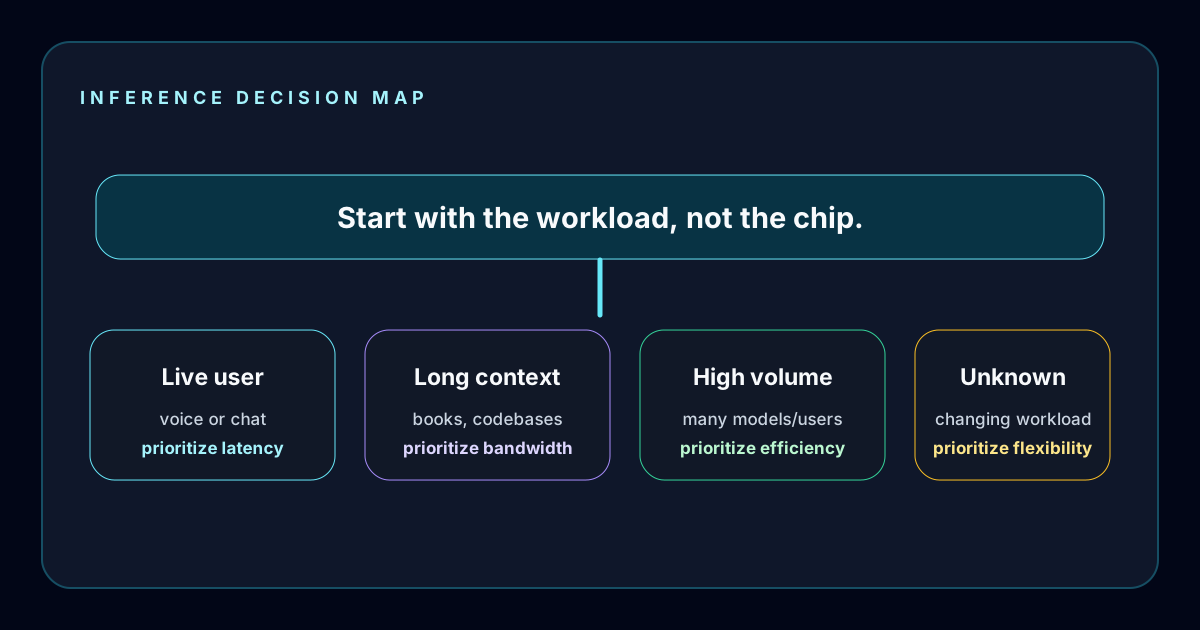
Hardware comparisons get noisy fast. Product architecture is calmer. Start with the experience you need to deliver. Does the answer have to feel immediate? Does the prompt include an entire codebase or legal record? Are you trying to reduce API spend at scale? Are you constrained by privacy, hosting, or procurement?
Then measure the workload in plain terms: input length, output length, concurrent users, latency target, model size, uptime requirement, and cost ceiling. Once those numbers are visible, the hardware conversation becomes much more grounded.
For many teams, the answer may still be a GPU-backed cloud model. For some teams, a specialized inference provider will be the difference between an impressive demo and a usable product.
{
  "application": "field_service_voice_assistant",
  "user_expectation": "natural conversation pace",
  "input_context": "customer record plus recent service notes",
  "main_risk": "awkward latency during live call",
  "architecture_decision": "route interactive turns to low-latency inference",
  "fallback_decision": "use general GPU-backed model for slower analysis tasks"
}
2026 Inference Market
The future is routing, not one universal chip.
The practical future is not a single winner. It is workload routing. Training, batch analysis, real-time conversation, long-context review, and local mobile inference can each land on different infrastructure.
That is good for product teams. It should push token prices down, make voice interfaces feel more natural, and make long-context tools less painful to use. It also raises the bar for architecture decisions. Teams need to understand when speed matters, when cost matters, and when reliability matters more than either.
For HerbDev clients, the lesson is straightforward: do not pick AI infrastructure because it sounds powerful. Pick it because it fits the workflow, the user experience, the maintenance plan, and the budget.
Reference link
This article was guided by Herb Trevathan's working notes and source discussion, then rewritten into the HerbDev learning style for business and technical readers.