Automating furniture repair and warranty claims
At a previous furniture repair job, service and warranty work crossed four systems. Here’s how I’d connect them and use separate predictions to get ahead of warranty claims and repeat visits.
Herb Trevathan · 5 min read
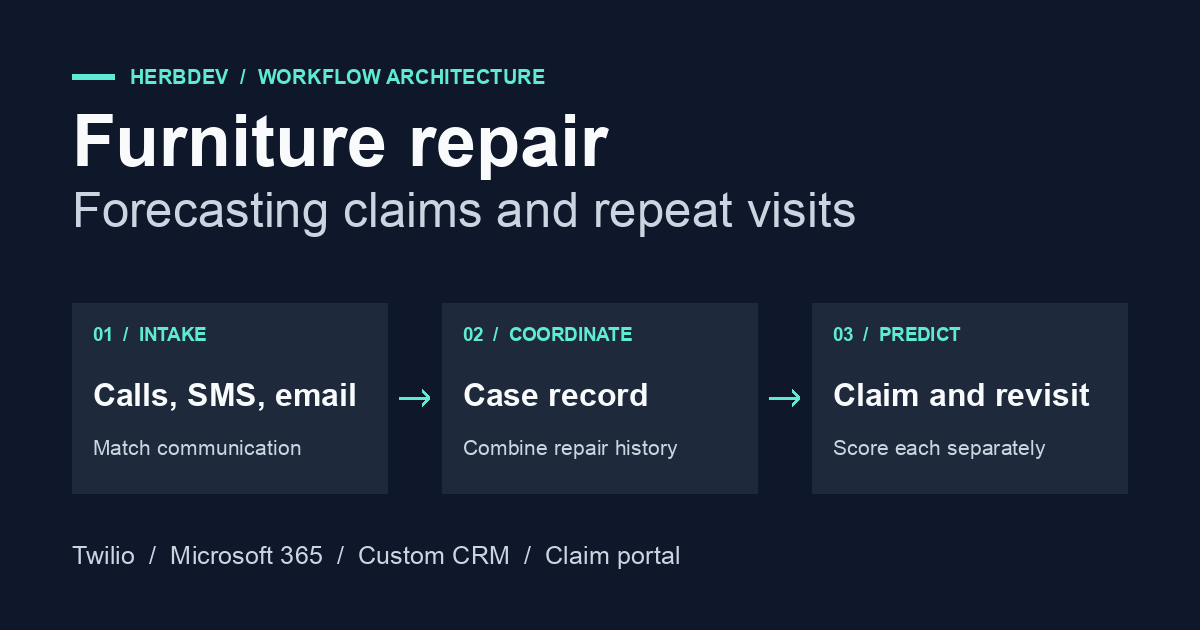
The problem I would automate
At my previous furniture repair job, we used Twilio for SMS and recorded phone calls, Microsoft 365 for email, a custom CRM for service work, and a custom portal in the warranty division for claims. A customer could describe a defect over the phone, send a photo by text, and confirm an appointment by email. The warranty team also needed the purchase and repair history when a case crossed over from field service.
I’d use that history to answer two questions early in the case. How likely is this repair to become a warranty claim? How likely is it to require another visit for the same issue? The first prediction helps the warranty team gather evidence sooner. The second helps dispatch check parts and technician availability before the first visit. This is a proposed architecture built around the systems we used.
Architecture using the existing systems
- Twilio
Texts and permitted call recordings - Microsoft 365
Service email and attachments - Custom CRM
Orders, visits and technician notes - Custom claim portal
Claim status and outcomes
- Match evidence to a CRM case
- Transcribe and extract facts
- Score claim and revisit likelihood
- Route actions through dispatch and warranty rules
In the proposed integration, Twilio events and Microsoft Graph mail notifications feed an intake queue. The case matcher uses CRM identifiers, order numbers and existing thread links. Ambiguous matches go to staff review. The claim portal contributes outcome history through an approved integration or export. Source IDs stay attached to every fact so staff can trace a prediction to the original message or service record.
- Whisper for speech. Transcribe authorized call recordings and retain timestamps for review.
- Open-weight Llama for evidence extraction. Read transcripts, SMS, emails and technician notes. Extract structured facts such as defect, part, purchase timing, and whether a prior repair addressed the same issue. Keep source references and mark missing or conflicting facts.
- Two supervised models for scoring. Train separate LightGBM classifiers on CRM and portal outcomes. Each model estimates one outcome using structured features such as item age, component affected, repair history and parts availability. Calibrate each score against actual outcomes.
Whisper is MIT-licensed and Llama weights are available under Meta’s community license. The model services can run in a controlled environment. Use permitted, de-identified histories for training and limit access to recordings and transcripts. Whisper license · Llama community license
How the two predictions change the workflow
- Customer contacts service
- CRM case is matched and scored
- Dispatch prepares or books a visit
- Technician findings trigger a rescore
- High repeat-visit likelihood. Ask dispatch to verify the part, match the technician to the repair, and allow enough time for the job. If the required part is unavailable, give the customer a revised plan before confirming the visit.
- High claim likelihood. Start collecting purchase evidence, photos, a written assessment, and an estimate. Recheck after a new message or technician finding. A new item with a significant repair is a reason to review the case against the applicable policy.
- Claim risk prompts evidence collection
- Check policy and complete the packet
- Submit eligible claim or route to review
- Log portal reference and notify teams
Example of a service call that becomes a claim
A customer calls about a recliner delivered last week and sends photos by SMS. The CRM shows a new purchase, and a follow-up email confirms the visit. After the technician reports a failed frame, the workflow updates both predictions. Dispatch checks whether parts or a second visit are needed. The warranty workflow checks coverage, assembles the verified purchase and repair evidence, and submits to the portal if the case qualifies for automatic submission. Otherwise it sends the packet to the warranty division for review.
For the decision controls behind the warranty path, see the Claims Decision Workflow architecture example.
Training, evaluation, and rollout
I would fine-tune Llama on labeled evidence extraction examples and train each classifier on the outcomes it needs to predict. For claim likelihood, define the target as a claim opened within an agreed window after intake. For repeat visits, count a return for the same defect within an agreed window after the first visit and track planned follow-ups separately. Keep cases without a full observation window out of the outcome training set.
Split the evaluation by time and keep all events for a case together. For each prediction, use only evidence available at that moment. Compare against simple rules and check both whether the probabilities match observed rates and how many cases a review threshold sends to staff. Missing or contradictory data can trigger manual review regardless of the score.
Start in shadow mode and compare predictions with staff decisions. Pilot dispatch prompts and warranty packet drafts before enabling submission for a narrow set of approved cases. Measure first-visit resolution, claim packet rework, and elapsed time from intake to submission alongside prediction quality. Keep model versions, evidence timestamps and staff overrides in the audit trail.